Open Channel Flow Meters

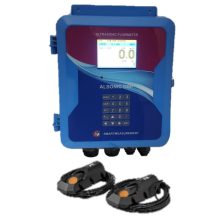
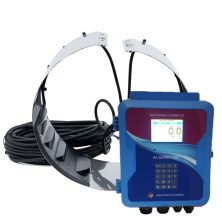
SmartMeasurement offers advanced Area Velocity Meter(AVM) open channel solutions, such as the non-intrusive Alsonic RAVM, as well as wetted transducer designs like the transit-time ALSONIC AVM and the Doppler-type ALSONIC-DAVM. For sewer pipes and other partially filled cylindrical conduits, the special-purpose ALSONIC-SAVM transit time meter is offered. Smartmeasurement offers smart solutions for your open channel application regardless of various open channel installation complications.

Need pricing or a product recommendation?

Featured Products

Explore SmartMeasurement’s most popular open channel flow meters—engineered for precise, non-intrusive measurement in water treatment, HVAC, energy, and industrial systems. Easily compare models by installation type, application, or feature set to find the right fit for your project.

Not sure which model fits your system? Talk to an Engineer for expert guidance.

Alsonicavm-Flowmeters

ALSONIC-AVM

Alsonic-Savm-Flowmeters

ALSONIC-SAVM

Alsonic-Davm-Flowmeter

ALSONIC-DAVM

Alsonic-Ravm-Flowmeter

ALSONIC-RAVM

Need help choosing the right open channel flow meter?
Our engineers can match you with the best model based on your specs and budget.

Why Choose SmartMeasurement’s Open Channel Flow Meters?

At Smart Measurement, we specialize in providing innovative and reliable open channel flow measurement solutions for a wide range of industries. Our extensive product line includes state-of-the-art ultrasonic transit-time, radar combined with microwave Doppler, partially filled magnetic as well as traditional Doppler open channel flow meters, each designed to deliver accurate and dependable performance in challenging environments. Our expert team is dedicated to helping customers find the perfect open channel flow meter for their unique needs, offering personalized support and customized solutions.

Non-Intrusive Measurement for Easy Maintenance

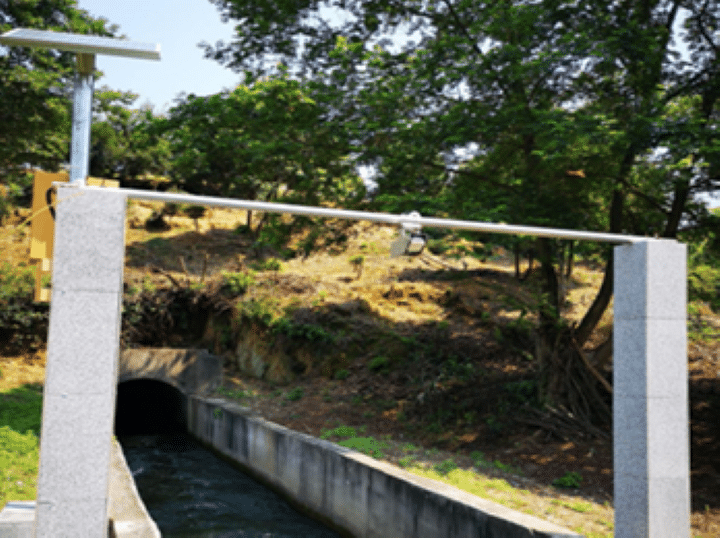
Utilizing microwave doppler with radar level transmitter our AlsonicRAVM meters measure open channel flow without ever touching the liquid to reduce fouling, wear, and ongoing maintenance

Ideal For Partially Filled Channels

Perfect for canals, streams, and sewer systems, these meters accurately calculate flow in trapezoidal, rectangular, and custom-shaped channels.

Customizable for Harsh Environments

Built with flexible sensor options and rugged enclosures, these meters perform reliably in outdoor, corrosive, or hazardous locations.

Solutions for Special Use Cases

ALSONIC-SAVM: Transit-Time Solutions for Sewers

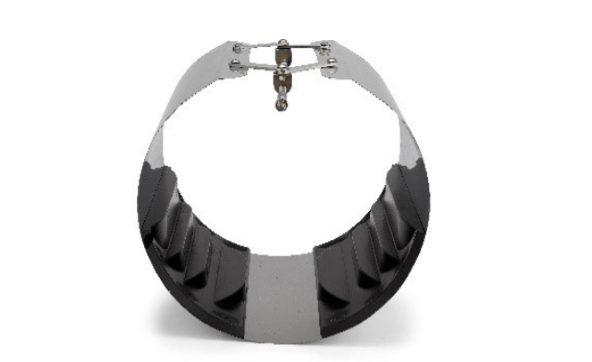
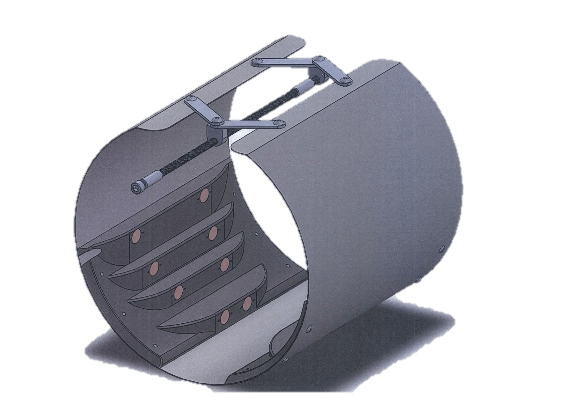
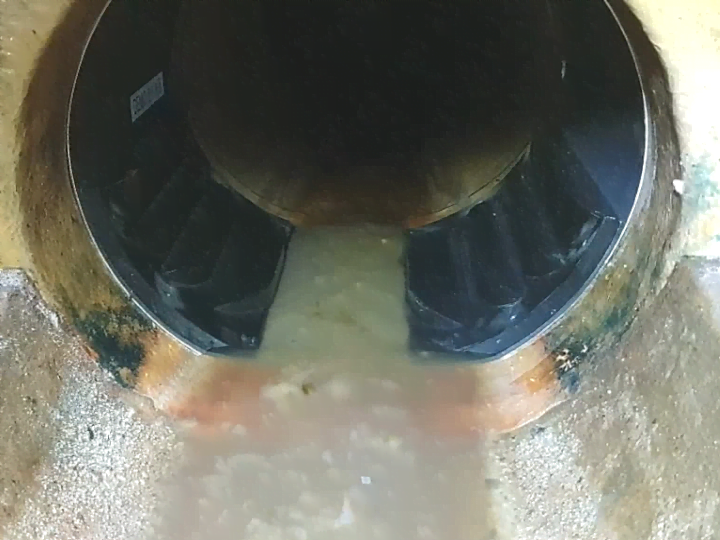
SmartMeasurement offers the ALSONIC-SAVM, a variant of the ALSONIC-AVM, specifically designed for cylindrical conduits like those in sewer systems. This model excels in profiling velocities in small channels, even with limited straight runs, making it ideal for sewer applications.

Design and Functionality

The ALSONIC-SAVM is tailored for sewer pipes or round conduits ranging from 6-60 inches (150-1500mm). It features the same display module as the ALSONIC-AVM but is equipped with a pre-configured cylindrical 3 or 4-path transducer array, ensuring easy installation. This array calculates flow velocity with the same high accuracy as the standard ALSONIC-AVM.

Efficient and Accurate

Designed for adaptability and precision, the ALSONIC-SAVM is an optimal solution for measuring flow in round sewer pipes without worrying about sedimentation or blockage  offering the reliability and accuracy synonymous with SmartMeasurement’s ultrasonic technology.

Discover more about our Ultrasonic Water Technology and its applications here.

Key Features and Functionality

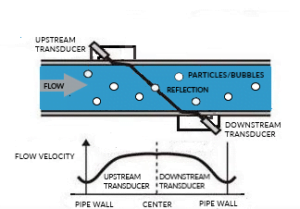
  • Advanced Transit Time Transducers: Able to measure very clean liquids as well as dirty liquids of up to 30% particles or bubbles. 
  • Ability to incorporate any Level Transmitter technologies: Users can choose any level technologies best suited for their application and connect the analog output to the SAVM flow computer for optimum Area Velocity Measurements.
  • High Accuracy: Accuracies of up to 0.5% of reading can be achieved for either clean or dirty liquids.

Advantages of ALSONIC-SAVM

  • Most accurate sewer system, or round channels  in the market: Accuracies of up to 0,5% of reading can be achieved for either clean or dirty liquids.
  • Easy Installation: Fits snugly inside cylindrical open channel conduits of 6-60 inches (150-1500mm)
  • Versatile Display Options: Graphic display providing signal strengths, sound speeds, and various information pertaining to open channel measurements.

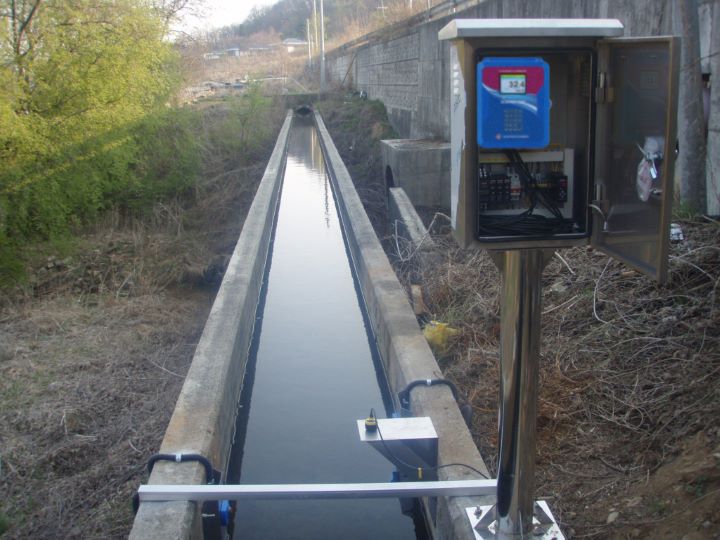
Examples of Open Channel Flow Meter Installations

ALMAGPF: Magnetic Flow Meter for Partially Filled Closed Pipes

To compensate for overflow due to rain and surges municipalities of times required swage piping in which the pipe is never full so to compensate for overflow flows. These are called partially filled pipes where standard flow metering requiring continuous filled pipes will not work. These partially filled applications require a flowmeter that measures fluid velocity as well as the liquid level in the pipe.

SmartMeasurement’s ALMAG PF is an electromagnetic Partially Filled Pipe Flow Meter featuring an electromagnetic flow velocity sensor combined with a ultrasonic liquid level sensor for a complete and continuous Area Velocity flow measurement. Users only need to input the inner diameter of a circular pipe, and the Almag PF will automatically calculate the flow rate in the pipe. The Almag PF transmitter automatically displays the instantaneous flow, flow velocity, cumulative flow and other measure- ment parameters in the pipeline. Compared with flowmeters measuring the flow rate by means of level measurement,, the obstruction-less ALMAG PF flow-meter is not affected by mud, sands and other solid sediment because the sensors are on the opposite sides of the flow body. It is also unaffected by waves or floating solids on the fluid surface.

Specifications

  • Used for partially filled closed pipes 
  • Pipe Sizes:2″-40″ (100-1000mm)
  • Accuracies of ±2.5% FS
  • For Liquids w/ electrical conductivity ≤ 100 μS/cm
  • 0-130°F(0-55°C)
  • Neoprene or Hard rubber liners with 316SS ,316L, Ti, Hastelloy C electrodes Flanged (DIN, ANSI, JIS etc.)
  • Applications are for storm surge, drainage systems, discharge control
  • Water and Wastewater, agricultural industries 
Almagwpf-Magnetic-Flow-Meter
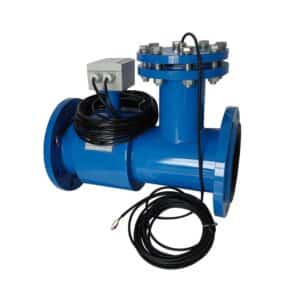
Almagpf partially filled magnetic flow meter with integrated electrodes and signal cable, designed for accurate flow measurement in partially full pipes and low flow conditions.
Almagwpf-Magnetic-Flow-Meters
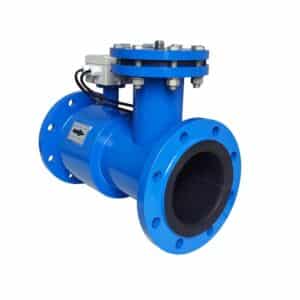
Almagpf partially filled magnetic flow meter shown from angle view, highlighting flanged connections and robust epoxy-coated body for industrial applications.

What Are Open Channel Flow Meters?

Open channel flow meters are specialized instruments designed to measure the flow of liquids in channels, streams, or partially filled pipes where the flow is not under pressure. Unlike traditional closed-pipe meters, they determine flow rate by calculating both the liquid level and velocity using separate sensors. Typically ultrasonic or electromagnetic for velocity, and any level technologies, for level measurement.

These meters rely on area-velocity measurement (AVM), combining data from both sensors and a flow computer to provide accurate, real-time flow profiling. Open channel flow meters are ideal for applications like wastewater treatment, irrigation systems, and stormwater monitoring. Compared to outdated flumes and weirs, which degrade and collect sediment over time, modern open channel meters offer far greater accuracy and long-term reliability without relying solely on channel shape.

How Open Channel Flow Meters Work

Area Velocity Flow Meters

Area velocity flow meters differ from other types by combining a velocity sensor with an ultrasonic level sensor to calculate the flow rate. This technology offers several advantages for certain applications, such as:

  • Accurate flow measurement in partially filled pipes or channels with irregular shapes
  • Ability to handle a wide range of flow rates and velocities
  • Reduced installation costs compared to flumes or weirs

Open channel flow meters rely on two key measurements to determine the flow rate:

  • Liquid level: The height of the liquid surface in the channel
  • Velocity: The average speed of the liquid flowing through the channel

By multiplying the cross-sectional area of the flow (calculated using the liquid level and channel dimensions) with the average velocity, the flow meter can accurately compute the volumetric flow rate using the following equation: Flow Rate (Q) = Cross-sectional Area (A) × Average Velocity (V)

Several technologies are employed in open channel flow meters to measure liquid level and velocity:

Open Channel Flow Meter Applications

SmartMeasurement’s open channel flow meters are designed for accurate, flow monitoring in partially filled pipes, culverts, channels, rivers, streams, etc.. These meters are ideal for a wide range of industry applications where pressurized flow measurement isn’t possible, offering precise readings with minimal maintenance. Common use cases include:

Water Resource Management

Monitor river, stream, and irrigation channel flow rates to optimize water usage, support conservation efforts, and manage reservoir releases. Ideal for agricultural and environmental flow monitoring.

Wastewater Treatment

Measure influent and effluent flow in treatment facilities to support compliance with EPA discharge regulations and improve process efficiency in municipal and industrial wastewater systems.

Stormwater and Drainage Systems

Track flow in stormwater channels, retention basins, and culverts to mitigate flood risk, manage runoff, and ensure regulatory reporting accuracy during peak weather events.

Industrial Effluent Monitoring

Accurately measure discharge flow from industrial facilities such as chemical plants, food processing plants, and manufacturing operations to ensure adherence to environmental standards.

Agricultural Irrigation Systems

Optimize irrigation flow in canals, ditches, and furrows with precise area-velocity measurement. Monitor water usage, improve crop yield efficiency, and meet regional water management requirements in both small-scale farms and large agricultural operations.

With wide pipe size ranges as well as compatibility across different liquid and gas types, SmartMeasurement’s open channel flow meters are the preferred choice for flow measurement solutions.

FAQs

Area Velocity Measurement (AVM) open channel flow meters are ultrasonic-based instruments that measure both fluid velocity and channel level simultaneously. All AVM meters require a secondary level measurement regardless of which ultrasonic technique is used to measure velocity. The velocity and level data are sent to an open channel flow computer, which applies the Manning Equation to calculate the complete open channel flow rate.
Flumes and weirs, known as primary elements, only measure the water level and infer flow based on the known geometry of their structure. They do not measure velocity directly. This makes them highly susceptible to inaccuracy: sedimentation in the flow path distorts the level reading, and corrosion of the primary element changes the geometry the calculation depends on. Area velocity meters measure both velocity and level independently, making them significantly more accurate and reliable.
All area velocity open channel flow meters measure both fluid velocity and channel depth. This data is transmitted to a flow computer, which applies Manning's Equation incorporating velocity, level, and channel shape to calculate the complete open channel flow rate. This approach is significantly more accurate than level-only primary element methods.

There are four primary technologies used in modern open channel flow measurement:


  1. Transit-time ultrasonic - measures velocity at multiple depths within the channel for the highest accuracy, used with a level transmitter.
  2. Doppler ultrasonic - a cost-effective wetted technology that works well in dirty or particle-laden flows, paired with a level transmitter.

  3. Microwave radar - a fully non-contact technology installed above the channel, measuring surface velocity and level without entering the flow stream.
  4. Magnetic flow meters - used for partially filled pipe applications, combined with an ultrasonic level transducer for accurate measurement.

Transit-Time Ultrasonic (wetted transducers)

Advantages: Most accurate open channel technology. Multiple sensors profile the full channel depth. SmartMeasurement's AlsonicAVM handles up to 30% particles or bubbles using high-frequency signals and advanced algorithms.

Limitations: Low-cost or low-frequency versions may struggle with high particle or bubble content.


Doppler Ultrasonic (wetted transducers)

Advantages: Cost-effective. Performs well in dirty fluids with bubbles and particles. Combined velocity and level transducer in one package, mounted at the channel bottom.

Limitations: Less accurate than transit-time, measuring only bottom-channel velocity. Susceptible to sedimentation. Fails in very clean fluids with no particles or bubbles.


Microwave Radar (non-intrusive)

Advantages: Completely non-intrusive, mounted above the channel. Channels stay fully operational during installation. Works well in dirty or particle-laden flows.

Limitations: Less accurate than transit-time, measuring only surface velocity (5 to 10% typical). Clean fluids without surface particles can cause signal errors. Some vendors offer flow profiling software to improve accuracy to 3 to 5%.

The best technology depends on several factors: accuracy required, budget, installation method, fluid type, channel shape and size, and whether the application involves a partially filled pipe or an open channel. Open channel flow measurement requires significantly more engineering judgment than standard pipe flow measurement. It is important to work with a vendor that offers all available technologies, transit-time, Doppler, microwave radar, and magnetic, to ensure the most appropriate solution for your specific conditions. Consulting with experts is strongly advised.

Accuracy depends on which area velocity technology is selected:

  • Transit-time ultrasonic with high-frequency signals and multi-transducer channel profiling: up to +/-1%
  • Microwave radar (surface velocity): typically 5 to 10%, improvable to 3 to 5% with flow profiling software
  • Doppler ultrasonic (bottom velocity): typically 5 to 10% with proper installation per manufacturer recommendations
Open channel applications are either water or wastewater. All of them can handle these fluids.
Because area velocity open channel flow meters have no moving parts, routine recalibration is not necessary under normal operating conditions. If a transducer or electronic component malfunctions, the meter will stop producing a reading entirely, at which point the affected component needs to be replaced. All replacement transducers are fully factory-calibrated before installation.
Zeroing is the process of calibrating the transducers to recognize a true zero condition, setting the velocity transducer to read zero velocity and the level transducer to read zero depth under static no-flow conditions. This baseline reference ensures accurate measurement across the full operating range. Zeroing is performed by following the instructions provided in the open channel flow computer's setup procedure.

The best approach depends on the technology in use:

  • Microwave radar - most robust for debris-heavy flows, installed above the channel with no contact with the fluid or solids.
  • High-frequency transit-time ultrasonic - capable of operating in flows containing up to 30% particles or debris using advanced signal processing algorithms.
  • Doppler ultrasonic - periodic manual cleaning of the transducer may be required. Most vendors provide a sedimentation alarm that alerts operators when the transducer face is fully covered.
Yes. Ultrasonic open channel flow technologies are capable of measuring very low fluid velocities. Transit-time ultrasonic meters can measure velocities as low as 0.02 meters per second, while Doppler ultrasonic meters can measure down to 0.1 meters per second. Low-flow measurement is not a limiting factor for any of the three major ultrasonic open channel technologies.

Ask an Engineer

Have a technical question? Get an expert answer in 24 hours.

Trusted by engineers in water treatment, HVAC, and industrial operations worldwide.

Ultrasonic Flow Meter Form

🔒Your information is secure. SSL encrypted.

Ask an Engineer

Need help from an engineer? Simply fill out this form below and one of our engineers will contact you soon!

Quotation Sidebar

Contact Information
Tell us more about your needs below, please be as specific as possible. * (required)

Ask an Engineer

Have a technical question? Get an expert answer in 24 hours.

Trusted by engineers in water treatment, HVAC, and industrial operations worldwide.

Ultrasonic Flow Meter Form

Your information is secure. SSL encrypted.