Liquid cooling has moved from the plant room to the rack. To keep AI and HPC servers within their temperature limits, operators now run coolant straight to cold plates on the processors, or sink whole servers into tanks of dielectric fluid.
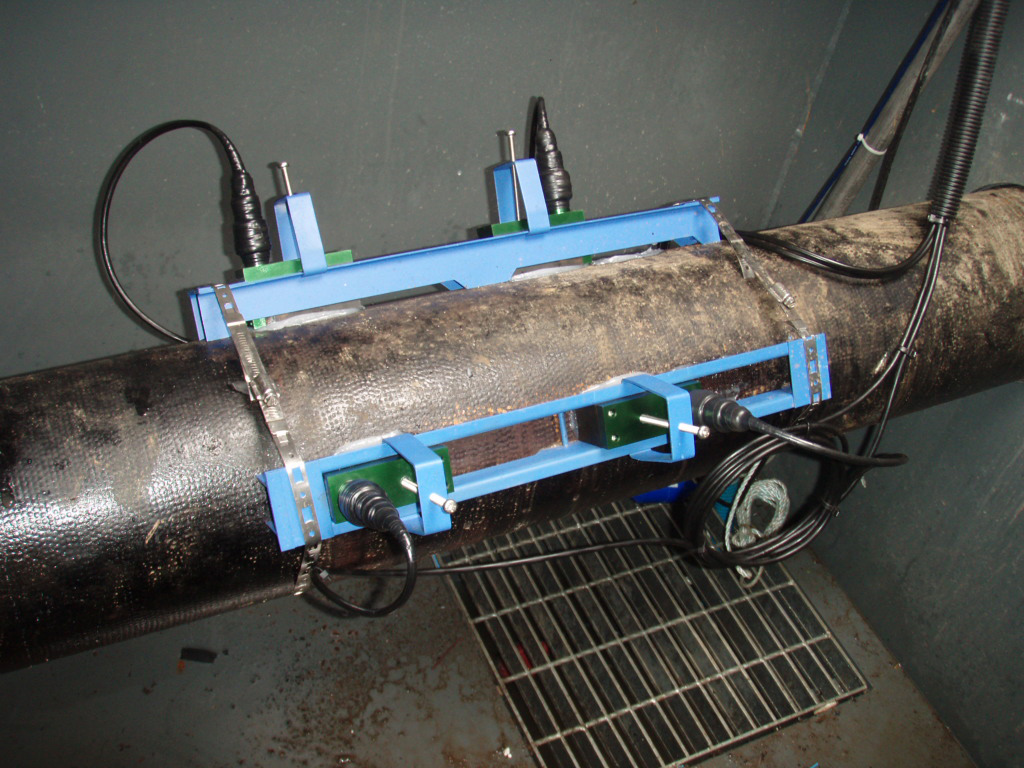
The flow meters on the facility’s chilled water usually can’t follow it there. Most are magnetic meters, and a magnetic meter only reads liquids that conduct electricity. Dielectric fluid doesn’t conduct by design, and deionized water barely does. If you need flow data on those loops, you need a Coriolis meter.
This article covers which coolants need which meter, and where SmartMeasurement’s ALCM Coriolis meters fit alongside magnetic ones.
Why measure flow at rack level?
A cold plate or immersion tank is designed around a minimum coolant flow. Drop below it, and the processors run hotter. The tricky part is that a problem in one branch rarely shows up at the CDU. Total flow can look normal while one manifold, starved by a partly closed valve or a clogged filter, leaves a row of servers running hot.
Measuring flow at rack level lets you confirm that each branch and tank gets its design flow at startup, and catch a weakening pump or blocked strainer before it turns into a hot spot. Add supply and return temperatures, and the same data shows how much heat each loop removes, which helps when you need to document performance for an owner or customer.
Which coolant, which meter
A magnetic flow meter works by measuring the small voltage a liquid generates as it moves through a magnetic field. No conductivity means no voltage, and no reading. SmartMeasurement’s magnetic meters need at least 5 µS/cm.
| Coolant | Typical use | Magnetic meter | Coriolis meter |
| Facility chilled water | Plant and CDU facility side | Yes | Yes |
| Inhibited water-glycol | Direct-to-chip secondary loops | Yes, if ≥5 µS/cm | Yes |
| Deionized water | Some direct-to-chip loops | No | Yes |
| Dielectric fluid | Single-phase immersion tanks | No | Yes |
Dielectric fluids are the clearest case. They are synthetic oils and engineered fluids chosen precisely because they don’t conduct electricity, which is what lets servers sit fully submerged in them. A magnetic meter can’t see them at all.
Deionized water is less obvious. Most of its minerals have been stripped out, and some direct-to-chip systems use it to keep the loop’s conductivity low. That can take it below what a magnetic meter needs.
Water-glycol is the most common direct-to-chip coolant, and most inhibited mixtures conduct well enough for a magnetic meter. Here either technology works, and the choice comes down to line size, budget, and whether you want density data.
How a Coriolis flow meter works
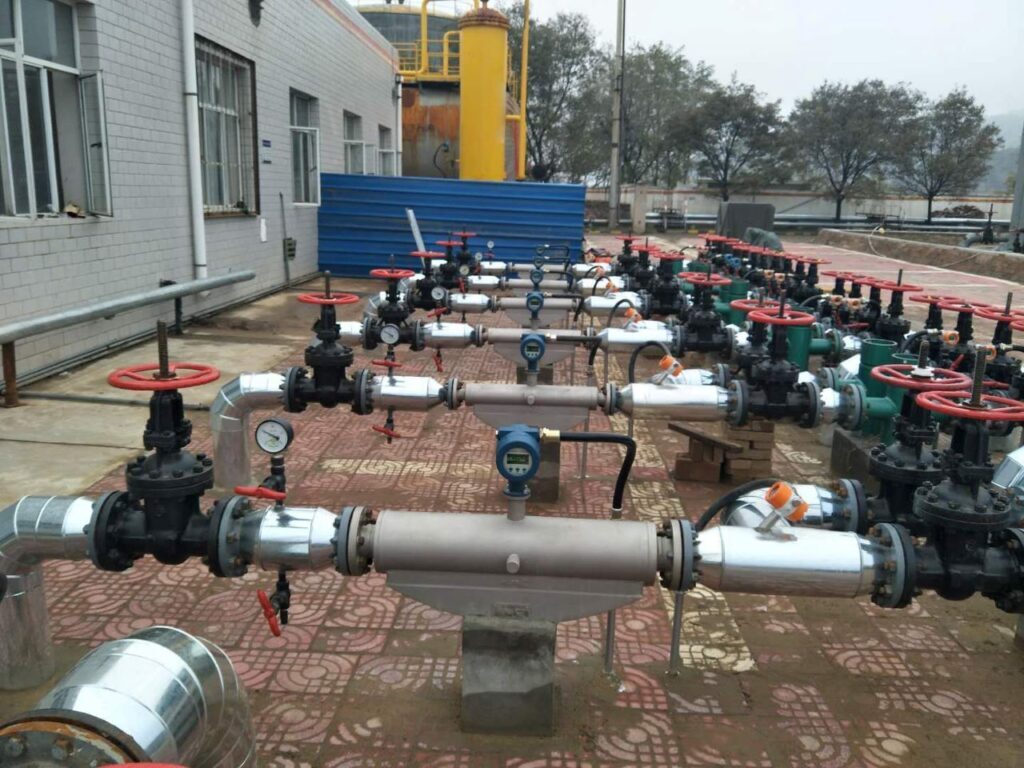
A Coriolis flow meter sends the liquid through tubes that vibrate at a set frequency. Moving liquid makes the tubes twist slightly, and sensors at each end measure the twist. The amount of twist is proportional to mass flow.
Because the meter responds to mass rather than electrical properties, conductivity doesn’t matter. Neither do changes in temperature, pressure, or viscosity. That helps with dielectric fluids, whose density shifts noticeably as they warm up.
What an ALCM meter measures
An ALCM meter reports mass flow, density, and temperature from a single instrument, and calculates volumetric flow from the first two. No extra sensors are needed.
Density is the reading people tend to overlook. A gradual change can point to coolant that has been diluted, contaminated, or is breaking down, so it’s worth trending alongside flow.
The ALCM range also brings:
- Accuracy options of ±0.1%, ±0.15%, ±0.2% or ±0.5% of reading
- A typical turndown of 100:1, so one meter covers both low and normal flow
- No straight-run requirement, which helps in cramped rack and tank piping
- A service life SmartMeasurement puts at more than 10 years without significant change to factory calibration
Where Coriolis fits in a liquid-cooled data center
In single-phase immersion, the dielectric fluid stays liquid the whole time. Pumps move it from the tank through a heat exchanger or CDU and back, and a Coriolis meter on that circulation line shows whether each tank is getting the flow it needs.
Two-phase immersion works differently. The fluid boils on the hot components, rises as vapor, condenses on a cooled coil, and drips back down. Coriolis meters can’t measure a mix of liquid and vapor, so in these systems they go only on lines that carry 100% liquid, such as fill, transfer, or filtration lines.
In direct-to-chip systems running deionized water, a Coriolis meter measures flow to the manifolds and cold plate branches where conductivity is too low for a magnetic meter.
Coriolis meters also earn their keep during commissioning. Every new liquid-cooled loop has to be purged and flushed before the racks go live, and flow readings are how you confirm and document that each branch is circulating as designed.
Choosing an ALCM model
The ALCM family runs from ⅛” to 12″ (3 to 300 mm). Two models cover most data center cooling loops:
| Model | Best for | Sizes | Temperature range |
| ALCM-DT (Delta Tube) | Low flows and small lines: cold plate branches and manifolds | ⅛” to 1″ (3 to 25 mm) | -58 to 356 °F |
| ALCM-MB (Micro-Bend) | Higher flows with low pressure drop: CDU secondary loops and immersion tank circulation | ¼” to 12″ (8 to 300 mm) | -40 to 662 °F |
Both come with accuracy options from ±0.1% to ±0.5% of reading.
Where magnetic meters still make more sense
Coriolis isn’t the right answer everywhere. SmartMeasurement’s own guidance puts Coriolis meters at roughly $4,000 to over $30,000 depending on size, which is more than a comparable magnetic meter. They also add more pressure drop than a full-bore magnetic meter, and they don’t like strong vibration from nearby pumps.
So wherever the coolant conducts, which covers facility chilled water, CDU facility-side piping, and most water-glycol loops, a magnetic meter is usually the better buy. Save Coriolis for the fluids that need it, or for loops where density data justifies the extra cost.
Quick selection guide
| Situation | Recommended meter |
| Facility chilled water, any line size | Magnetic (ALMAG series) |
| CDU facility-side piping | Magnetic (ALMAG series) |
| Conductive water-glycol secondary loop | Magnetic, or Coriolis if density data is needed |
| Deionized water loop | Coriolis (ALCM series) |
| Single-phase immersion circulation | Coriolis (ALCM series) |
| Two-phase immersion | Coriolis, on 100%-liquid lines only |
Installing a Coriolis meter at rack level
A few habits make a big difference to accuracy. Coriolis meters need their tubes completely full, so install them for upward flow where you can; that stops gas from collecting inside. Newly filled loops tend to carry air, and since the meter needs 100% liquid, fit an air eliminator upstream.
Keep the meter away from pumps, or support it so pipe vibration doesn’t reach it. And size it from the loop’s minimum, normal, and maximum flow rates, not from the pipe diameter.
Frequently asked questions
Can a flow meter measure dielectric immersion cooling fluid?
Yes, if it’s a Coriolis meter. It measures the fluid by mass, so conductivity doesn’t matter. A magnetic meter can’t, because dielectric fluids don’t conduct electricity.
What flow meter works with deionized water?
A Coriolis meter. Deionized water’s conductivity can fall below the 5 µS/cm a magnetic meter needs.
Can Coriolis meters measure water-glycol coolant?
Yes, along with its density and temperature. A magnetic meter also works if the mixture is conductive, and it usually costs less.
Can a Coriolis meter measure two-phase immersion cooling?
Only on lines carrying 100% liquid. Coriolis meters can’t measure a mix of liquid and vapor.
Do Coriolis meters need straight pipe runs?
No. They can go right after bends, valves, and fittings.
The bottom line
At rack level, the coolant picks the meter. If it conducts, a magnetic meter is usually the economical choice. If it doesn’t, or if you want density alongside flow, a Coriolis meter measures what a magnetic one can’t, with accuracy up to ±0.1% of reading.
To see how both technologies fit across the plant, CDU, and rack, visit SmartMeasurement’s data center cooling flow meters page. Or send your coolant, line size, flow range, and temperatures, and an application engineer will recommend a meter.