Water infrastructure plays an essential role in industrial operations, municipal distribution networks, manufacturing facilities, and wastewater treatment plants. Accurate water flow measurement helps facilities monitor consumption, manage resources, identify unusual flow conditions, and maintain efficient processes. However, many facilities still depend on aging mechanical meters and outdated analogue measurement equipment that may no longer meet modern operational requirements.
As water infrastructure continues to age, upgrading measurement equipment is becoming an important consideration for facility managers and industrial operators. An outdated industrial water flow meter can create measurement inconsistencies, increase maintenance requirements, and make it more difficult to monitor water usage accurately.
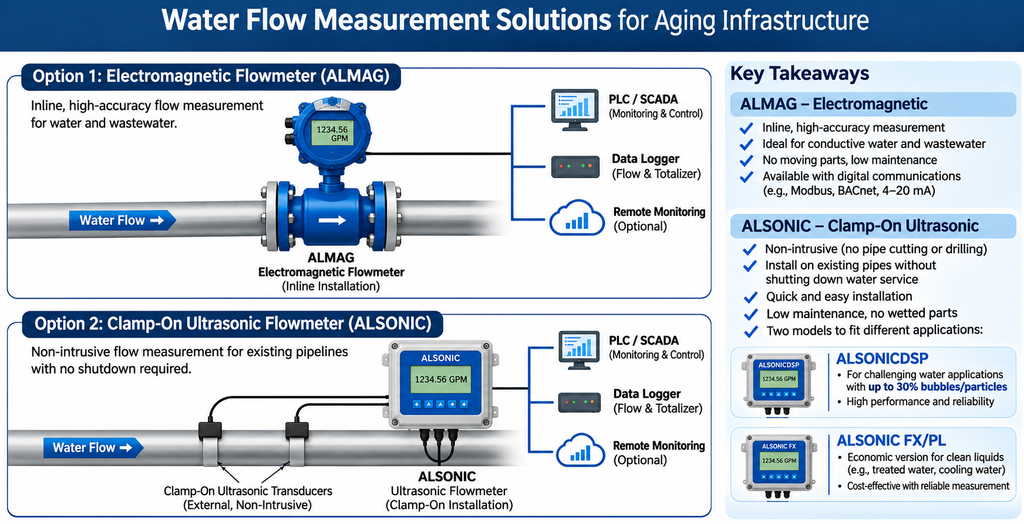
Replacing older equipment with modern technologies, such as electromagnetic flow meters, can help facilities improve measurement reliability and gain better visibility into their water distribution systems. For sites where shutting down or modifying an existing water pipeline is impractical, non-intrusive clamp-on ultrasonic flow measurement offers an additional upgrade path.
But how do operators know when it is time to upgrade? Understanding the warning signs and available technologies can help organizations make informed replacement decisions.
Why Aging Water Flow Meters Become a Problem
Industrial water flow meters operate under different conditions depending on the application. Some measure clean process water, while others monitor cooling water, wastewater, or liquids containing suspended solids.
Over time, measurement equipment can experience wear, component deterioration, calibration issues, and changes in performance. Older mechanical meters may also contain moving parts that are exposed to friction, deposits, and mechanical stress.
Analog instruments can create additional challenges when facilities need more accessible measurement information or integration with modern monitoring systems.
Common problems associated with aging flow meters include:
- Inconsistent or inaccurate flow readings.
- Increased maintenance and inspection requirements.
- Mechanical wear and deterioration.
- Difficulty identifying unexpected water losses.
- Limited communication and monitoring capabilities.
- Challenges obtaining reliable historical measurement data.
These problems can affect operational planning, water management, and process control. Regularly reviewing flow meter performance helps facilities determine whether existing equipment remains suitable for current requirements.
5 Signs Your Facility Should Replace Its Industrial Water Flow Meter
Recognizing early warning signs can help prevent measurement problems from becoming more disruptive.
1. Frequent Measurement Inaccuracies
One of the most important reasons to consider flow meter replacement is recurring measurement inconsistency.
If flow readings regularly differ from expected operating conditions or cannot be reconciled with other measurement points, the instrument may require inspection, recalibration, or replacement.
Mechanical wear, damaged components, installation problems, and changing process conditions can all contribute to inaccurate readings.
Facilities should investigate repeated discrepancies rather than assuming that unusual readings are simply normal operating variations.
2. Increasing Maintenance Requirements
Older mechanical flow meters may require more frequent servicing as internal components deteriorate.
Moving parts can become affected by friction, corrosion, deposits, and suspended material, depending on the liquid and operating environment. Repeated repairs can increase maintenance costs and create additional operational interruptions.
When maintenance becomes frequent or replacement parts become difficult to obtain, upgrading to a technology with fewer moving components may be a more practical long-term decision. Both electromagnetic and clamp-on ultrasonic flowmeters avoid the moving measuring elements found in many mechanical meters. Clamp-on ultrasonic sensors also remain outside the pipe, avoiding direct exposure to the water and simplifying access for inspection or servicing.
3. Limited Water Infrastructure Monitoring
Modern industrial facilities increasingly rely on measurement data to understand water consumption and system performance.
Older analog instruments may provide limited information and may not easily integrate with centralized monitoring or control systems.
Without accessible flow data, operators can find it difficult to compare water usage across different areas, identify unusual consumption patterns, and investigate potential distribution problems.
Upgrading to a compatible digital magnetic or ultrasonic flow measurement solution can improve access to operating information and support more effective water infrastructure monitoring. Available communications depend on the selected model and configuration.
4. Unexpected Water Losses or Consumption Changes
Unexplained increases in water consumption can indicate leaks, process changes, equipment problems, or measurement errors.
An aging flow meter may not provide the consistency required to distinguish actual changes in water usage from measurement-related discrepancies.
Facilities should compare readings from relevant measurement points, inspect pipelines, and review operating conditions before identifying the source of a problem.
Reliable flow measurement can help operators investigate unusual consumption patterns and make better-informed maintenance decisions. Where access is available, clamp-on ultrasonic measurement may also be used to assess flow at selected existing pipe locations without opening the pipeline.
5. Difficulty Maintaining Existing Equipment
Some older instruments may become increasingly difficult to support because manufacturers discontinue components or replacement parts become expensive and difficult to source.
When an instrument approaches the end of its practical service life, facilities should evaluate the cost of continued maintenance against the benefits of installing a modern alternative.
Replacement planning can also provide an opportunity to review whether the existing meter is correctly sized and suitable for current operating conditions. Where a shutdown would be costly, a suitable clamp-on ultrasonic meter may provide a practical non-intrusive alternative to installing another inline meter.
Why Consider Magnetic Flow Meters for Industrial Water Measurement?
Magnetic flow meters, also known as electromagnetic flow meters, are widely used for measuring electrically conductive liquids.
They operate according to Faraday’s law of electromagnetic induction. As a conductive liquid passes through a magnetic field, it generates a voltage proportional to its velocity. The instrument measures this voltage and calculates the volumetric flow rate.
Unlike conventional mechanical meters, magnetic flow meters have no moving parts in the measuring tube. This design can reduce mechanical wear and help minimize maintenance requirements.
Key advantages include:
- No moving parts: Reduces mechanical wear associated with rotating components.
- Low pressure loss: The unobstructed measuring tube allows liquid to pass through without the restrictions associated with many mechanical designs.
- Suitable for conductive liquids: Supports measurement of water and other compatible conductive fluids.
- Suspended solids capability: Appropriate models can measure many conductive liquids containing suspended particles.
- Digital measurement options: Depending on the model, available outputs can support integration with industrial monitoring and control systems.
An important consideration is that electromagnetic flow meters require sufficient liquid conductivity. They are not suitable for every fluid, so the conductivity of the process liquid must be checked against the selected instrument’s specifications.
How ALMAG Magnetic Flow Meters Support Infrastructure Upgrades
SmartMeasurement’s ALMAG magnetic flow meter range provides electromagnetic measurement solutions for suitable industrial liquid applications.
When facilities evaluate older mechanical or analog instruments, ALMAG technology can be considered for applications where reliable measurement of conductive liquids is required.
Potential applications include:
- Industrial water distribution networks.
- Cooling-water circulation systems.
- Water treatment facilities.
- Wastewater treatment processes.
- Manufacturing and process-water monitoring.
- Conductive liquid measurement in industrial pipelines.
Depending on the selected model and configuration, magnetic flow measurement can also provide output options for connecting instruments to existing monitoring and control infrastructure.
For facilities planning an upgrade, the important step is to match the instrument to the actual operating conditions rather than selecting a replacement based only on the existing meter’s pipe size.
Clamp-On Ultrasonic Flow Measurement: A Non-Intrusive Alternative
For customers who prefer not to cut into an existing pipeline, SmartMeasurement’s ALSONIC clamp-on ultrasonic flowmeters offer another choice alongside ALMAG magnetic meters. Ultrasonic transducers attach to the outside of a suitable pipe and measure flow through the pipe wall. Unlike inline meters, the installation does not require opening the pipe or placing sensors in contact with the water.
This approach is especially attractive for operating water distribution lines, cooling-water circuits, and industrial process-water systems where a shutdown would interrupt production or service. Subject to site access and installation suitability, transducers can be fitted while water continues flowing, avoiding the draining, pipe cutting, and restart activities associated with many inline meter replacements.
Additional benefits include:
- Non-intrusive installation: External transducers do not contact the process water.
- No planned water shutdown for sensor installation: Suitable existing pipes can often be instrumented while remaining in service.
- Simplified installation and relocation: No new flanges or spool-piece modifications are required for the clamp-on sensors.
- Accessible maintenance: Externally mounted sensors can be inspected or serviced without opening the process line.
- No added flow obstruction: Clamp-on sensors do not introduce an internal restriction or associated pressure loss.
Clamp-on ultrasonic measurement is not appropriate for every installation. Suitability depends on pipe material, wall thickness, lining, diameter, available straight-run conditions, and the acoustic properties of the liquid. The pipe generally must remain full, and entrained air or excessive solids can affect performance, particularly for transit-time systems. Application conditions and the selected ALSONIC model should therefore be reviewed before specifying the meter.
ALMAG remains an excellent option for many conductive-water and wastewater applications, including duties involving suspended solids. ALSONIC offers customers a complementary, non-intrusive choice when avoiding downtime and pipe modifications is a major priority.
What Should Facilities Consider Before Replacing a Flow Meter?
Replacing an industrial water flow meter requires more than selecting a newer instrument. Engineers and facility managers should review several technical and operational factors.
1. Pipe size and material
Confirm the pipeline diameter, material, lining, and connection requirements to ensure the selected meter is compatible with the installation. For clamp-on ultrasonic measurement, pipe wall thickness, coating, and acoustic compatibility also matter.
2. Water conductivity and liquid characteristics
Check the electrical conductivity of the liquid. This is particularly important when considering a magnetic flow meter. For ultrasonic measurement, also evaluate entrained air, suspended solids, and whether the liquid and pipe support reliable ultrasonic signal transmission.
3. Flow range
Determine the minimum, normal, and maximum flow rates. The replacement instrument should operate within the application’s required measurement range.
4. Pressure and temperature
Review operating pressure and temperature to confirm that the meter’s materials and specifications are appropriate. For clamp-on systems, confirm the transducer and mounting temperature limits.
5. Installation conditions and downtime
Evaluate available straight pipe lengths, grounding requirements for magnetic meters, electrical connections, and whether the pipeline can remain full during measurement. Determine whether an inline installation requires a shutdown. If maintaining uninterrupted water service is critical, assess whether external clamp-on ultrasonic sensors can be installed on a suitable accessible pipe section.
6. Monitoring and communication requirements
Determine whether the replacement needs analog outputs, pulse outputs, or digital communication options compatible with the facility’s existing control system. Verify the specific outputs offered by the chosen ALMAG or ALSONIC configuration.
A careful evaluation can help avoid installation issues and ensure that the replacement provides useful measurement information.
The Long-Term Value of Upgrading Water Measurement Equipment
Modernizing flow measurement equipment can support more effective water management across industrial facilities.
Reliable measurements help operators understand consumption, compare performance between process areas, and investigate unusual flow conditions. Digital measurement capabilities can also make relevant operating data easier to access when integrated with suitable monitoring systems.
Although replacing aging equipment requires an initial investment, evaluating the long-term costs of maintenance, downtime, measurement uncertainty, and operational inefficiencies can help facilities determine whether an upgrade is worthwhile. For facilities unable to interrupt water service, a suitable clamp-on ultrasonic installation can reduce disruption and avoid invasive piping work.
Aging flow meters can create challenges for industrial water management, particularly when measurement inaccuracies, frequent maintenance, and limited monitoring capabilities begin affecting daily operations.
Replacing outdated mechanical or analog instruments with modern measurement technologies can help facilities improve measurement reliability and support better water infrastructure monitoring.
For suitable conductive-liquid applications, ALMAG magnetic flow meters from SmartMeasurement offer an alternative to conventional mechanical measurement equipment, with no moving parts in the measuring tube and options for industrial monitoring integration. Where a non-intrusive approach is preferred, SmartMeasurement ALSONIC clamp-on ultrasonic flowmeters provide an additional choice for compatible water pipelines, often without shutting down water service.
Facilities should assess their current instruments, operating conditions, and measurement requirements before planning a replacement.
Ready to modernize your water measurement system? Contact SmartMeasurement to discuss your application and explore both ALMAG magnetic and ALSONIC clamp-on ultrasonic flow measurement options for your industrial water measurement requirements.
Ultrasonic Measurement Key Takeaways
Clamp-on ultrasonic measurement is an additional option alongside ALMAG magnetic flowmeters, not a replacement for them. Where the pipe material and installation conditions are suitable, externally mounted transducers can be installed without cutting the pipe or interrupting water service, and they remain accessible for maintenance.
- ALSONIC-DSP: Consider for more challenging water applications with entrained bubbles or suspended particles, with capability up to 30% bubbles/particles subject to application and installation review.
- ALSONIC-FX / ALSONIC-PL: Economical clamp-on options for clean liquids, where ultrasonic signal quality and installation conditions are suitable.
ALMAG magnetic flowmeters: Continue to offer permanent inline measurement for conductive water applications, including applications where external clamp-on measurement is less suitable.