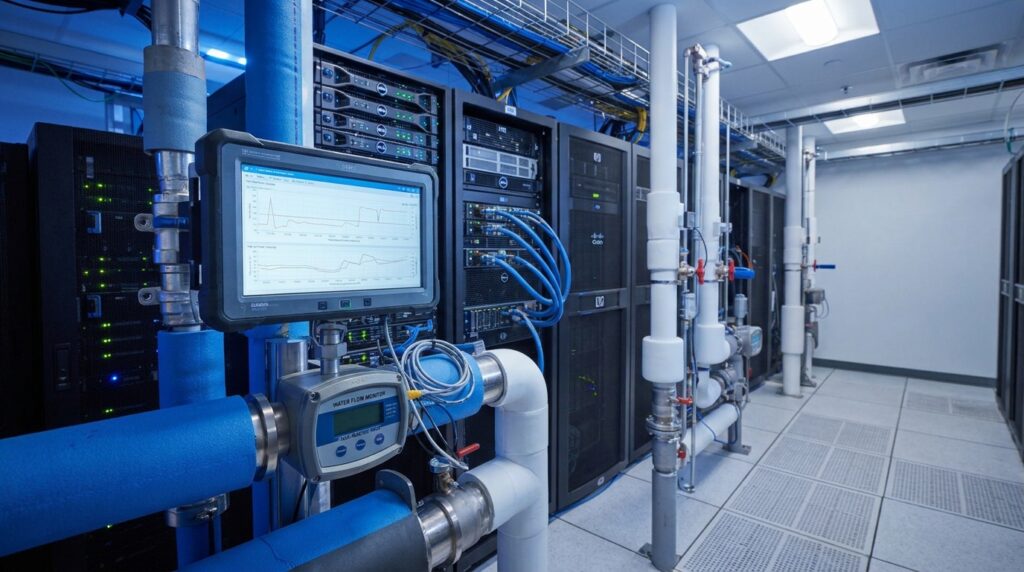
Modern data centres depend on reliable cooling systems to maintain the operating conditions required by servers, networking equipment, storage systems, and other critical infrastructure. As computing densities increase, particularly with high-performance computing and AI workloads, cooling systems need to deliver more predictable and measurable performance.
Water-based cooling systems are an important part of this infrastructure. Chilled-water loops, condenser-water systems, heat exchangers, cooling distribution systems, and liquid-cooling equipment all depend on controlled fluid movement. However, knowing that water is circulating is not enough. Data-centre operators need to understand how much water is flowing, where it is flowing, and whether the flow is consistent with the cooling demand.
This is where accurate flow measurement becomes an important part of thermal management.
Why Cooling Water Flow Matters in Data Centres
A cooling system can only transfer heat effectively when the required amount of cooling fluid reaches the appropriate equipment. If flow is too low, certain areas may not receive enough cooling capacity. If flow is unnecessarily high, pumps may consume more energy than required, and the system may operate inefficiently.
Temperature sensors can tell operators how hot or cold a fluid is, but temperature alone does not tell the complete story. Combining temperature information with flow measurement can provide a better understanding of how cooling systems are performing.
For example, operators may monitor:
● Chilled-water supply flow
● Chilled-water return flow
● Condenser-water flow
● Flow through cooling distribution systems
● Flow through heat exchangers
● Flow to individual cooling zones
● Flow in retrofit or temporary cooling systems
● Thermal energy transferred through a cooling loop
This information can help engineering teams identify changes in system performance before they become larger operational problems.
What Can Happen When Cooling Water Flow Is Not Properly Monitored?
A cooling system may continue operating even when flow distribution is not ideal. This makes measurement particularly important.
Potential problems can include:
Uneven cooling distribution
Different branches of a cooling system may experience different flow rates. Some equipment may receive more cooling fluid than necessary while other areas receive less.
Pump inefficiency
If pumps are moving more water than the system requires, the additional flow can contribute to unnecessary energy consumption.
Restricted flow
Valves, filters, pipe restrictions, or other components can affect the expected flow rate. Monitoring can help identify unusual changes.
Leakage
Unexpected changes in flow can sometimes provide an indication that a cooling loop requires further investigation.
Difficulty verifying system performance
Without flow data, operators may have limited information when assessing whether a cooling system is performing according to its design requirements.
Why Magnetic Flow Meters Are Widely Used in Data Centre Cooling
For permanent monitoring of chilled-water and condenser-water loops, the Magnetic Flow Meter is one of the most widely specified technologies in data-centre cooling systems, and for good reason.
Chilled water, condenser water and most water-glycol mixtures used in cooling loops are electrically conductive. A magnetic flow meter uses Faraday’s law of electromagnetic induction to measure the velocity of a conductive liquid as it passes through a magnetic field inside the meter. This makes the technology well suited to the water-based fluids used throughout data-centre cooling.
Several characteristics make magnetic technology a strong fit for this application:
No moving parts. There is nothing in the flow path to wear, stick, or require routine replacement, which supports long-term reliability in facilities that operate around the clock.
Full-bore, unobstructed design. The meter does not restrict the pipe, so it effectively adds no pressure loss. This matters in cooling systems, where every additional restriction increases the work the pumps must do.
High accuracy. Smart Measurement’s ALMAG Series offers ±0.5% of reading as standard. Accurate flow data is the foundation of reliable thermal-energy calculations.
Bi-directional measurement. Flow can be measured in both directions, which is useful in loops where flow direction may change between operating modes.
For these reasons, magnetic meters are a common choice for permanent installations on chilled-water supply and return lines, condenser-water circuits, and the branch lines that feed cooling distribution equipment. Where only flow rate is needed, the value-priced ALMAG-WP is Smart Measurement’s general-purpose magnetic meter, used in cooling water and heat exchanger applications.
The main requirement is conductivity. ALMAG meters require a minimum fluid conductivity (typically 5 µS/cm or higher, depending on the model), so operators using very low-conductivity fluids, such as deionised water in some secondary liquid-cooling loops, should confirm suitability before specifying a magnetic meter.
Using the ALMAG-EG and ALMAG-SS for Cooling and Thermal Energy Monitoring
Where operators need to understand the cooling energy being delivered, not just the volume of water moving, the ALMAG-EG Electromagnetic Energy Flow Meter combines magnetic flow measurement with temperature measurement and energy calculation.
The ALMAG-EG is available in line sizes from ½” to 120″ (15 to 3000 mm), covering everything from smaller branch circuits to large chilled-water headers. It works with PT100 and PT1000 temperature sensors, displays total energy flow alongside flow rate and totalised flow, and its unobstructed design provides low pressure loss and good tolerance of particles in the fluid. Smart Measurement also identifies the ALMAG-EG as well suited to cooling applications with low differential temperatures.
For smaller lines, the ALMAG-SS is a compact, all stainless steel spool-piece magnetic meter available in sizes of ½” to 2″ (15 to 50 mm). It is designed especially for cooling and energy measurement where a more rugged magnetic meter is required, and can provide flow, temperature, and BTU measurement.
Smart Measurement notes that both the ALMAG-EG and ALMAG-SS are particularly suited to chilled-water applications, and that they can be used where the fluid contains more bubbles or particles than is recommended for ultrasonic energy meters.
Adding Magnetic Measurement to Existing Facilities
Because an inline magnetic meter is flanged or threaded into the pipe, it is ideally specified at the design stage or installed during a planned maintenance window. For large existing pipelines where a shutdown is not practical, Smart Measurement offers the ALMAG-IS Insertion Electromagnetic Flow Meter. It suits pipe diameters from 2″ to 120″ (50 to 3000 mm), and a hot-tap ball valve option allows the sensor to be installed and retracted without shutting down the process. Its accuracy (±1.5%) is lower than a full-bore meter, but it brings magnetic measurement to a live cooling header.
Where Clamp-On Ultrasonic Meters Fit
Where installing an inline meter is not practical, the Ultrasonic Flow Meter offers a complementary, non-invasive option.
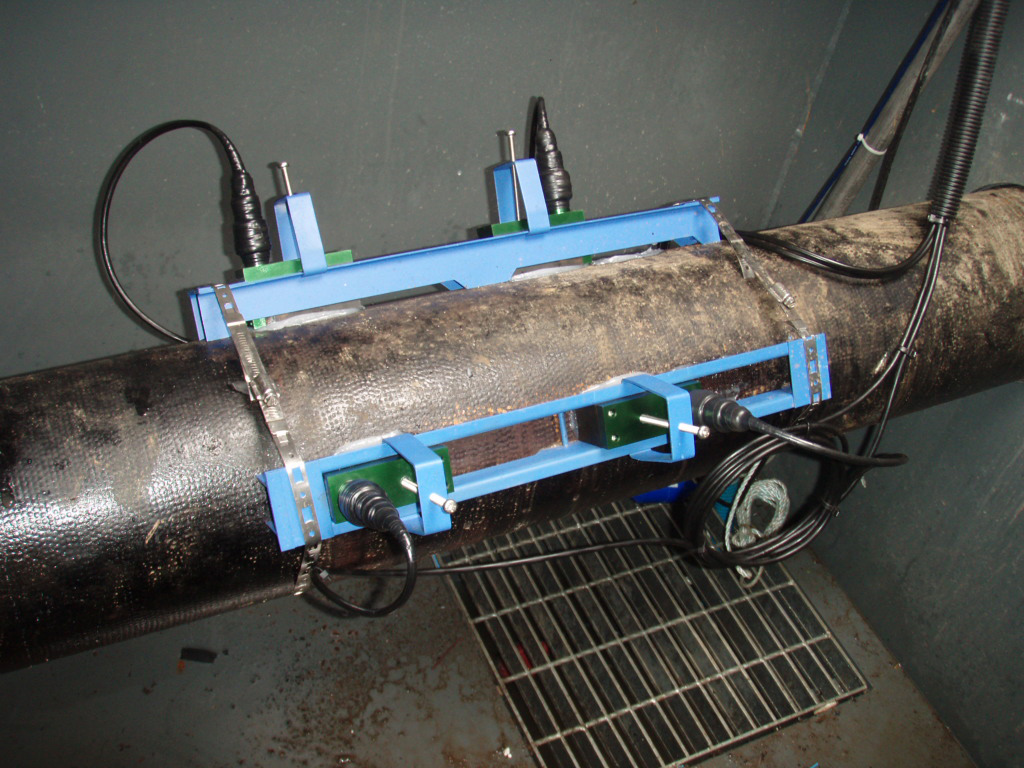
Smart Measurement ALSONIC Series provides ultrasonic flow measurement for liquid applications, including HVAC and cooling-related applications. The company offers both fixed and portable clamp-on configurations. Clamp-on ultrasonic technology measures flow from sensors installed externally on the pipe, which can be particularly useful where modifying an existing cooling-water system is undesirable.
Unlike a conventional inline installation that may require pipe modification, a clamp-on installation can be performed without cutting the pipe or interrupting the process flow. Smart Measurement describes its clamp-on ultrasonic meters as non-invasive solutions designed to avoid pipe cutting and system downtime.
Using the ALSONIC-EG for Non-Invasive Thermal Energy Monitoring
For applications where operators need energy data but cannot modify the pipe, the ALSONIC-EG Ultrasonic Energy Flow Meter provides a clamp-on alternative.
The ALSONIC-EG is designed to measure flow, temperature, and thermal energy consumption. Smart Measurement states that its transducers can be clamped onto pipes without cutting the pipe or shutting down the flow, making the technology suitable for retrofit applications.
The ALSONIC-EG can also communicate data using protocols including Modbus, BACnet, and M-Bus for integration with building-management systems. This can allow flow and energy information to become part of a wider monitoring environment rather than remaining isolated at the meter.
The trade-off is accuracy. Smart Measurement’s own guidance notes that clamp-on ultrasonic energy meters typically achieve 1-2% accuracy, lower than electromagnetic energy meters, which makes the ALSONIC-EG best suited to installations where avoiding pipe modification is the priority.
Non-Invasive Measurement for Retrofits and Audits
Data-centre cooling systems are often already installed and operational. Adding instrumentation can therefore be more complicated than specifying a meter for a new facility.
Smart Measurement’s clamp-on range includes the ALSONIC FX, a fixed-mount transit-time ultrasonic flow meter designed for non-invasive liquid flow measurement. The product supports a broad range of pipe sizes and includes standard outputs such as Modbus, analogue, and pulse outputs.
For temporary investigations or commissioning work, portable equipment such as the ALSONIC-DSP can also be useful. Smart Measurement describes its portable clamp-on ultrasonic meters as suitable for flow verification, maintenance checks, and system audits.
Between permanently installed magnetic meters and clamp-on or portable ultrasonic equipment, operators can use flow measurement at every stage of a data-centre project:
- Initial system assessment
- Commissioning
- Flow verification
- Troubleshooting
- Performance monitoring
- Retrofit monitoring
- Ongoing maintenance
Integrating Flow Data into Data Centre Monitoring
Flow measurement becomes more useful when it can be compared with other operating parameters.
For example, engineering teams can evaluate flow alongside:
● Supply temperature
● Return temperature
● Pump status
● Valve position
● Cooling demand
● Thermal energy consumption
● Equipment load
● Historical flow trends
Flow and energy data from permanently installed meters can be brought into building-management systems. The ALSONIC-EG, for example, supports Modbus, BACnet, and M-Bus, and Smart Measurement can advise on the output and communication options available for each ALMAG model. This provides an opportunity to incorporate cooling-flow information into a broader building automation strategy.
Monitoring Rather Than Guessing
When engineers have reliable flow data, they have a stronger basis for investigating questions such as:
● Is the expected amount of cooling water reaching a particular circuit?
● Has flow changed compared with historical operation?
● Is a cooling branch behaving differently from another branch?
● Is a pump delivering the expected flow?
● Has a retrofit changed the system’s hydraulic behaviour?
● Is thermal energy transfer consistent with expectations?
Flow measurement does not replace temperature monitoring, pressure measurement, controls, or engineering analysis. Instead, it adds another important measurement point to the cooling system.
Conclusion
Cooling-water management is becoming increasingly important as data-centre infrastructure becomes more complex and computing loads increase. Accurate flow information can help operators understand how cooling systems are performing, identify unusual conditions, verify distribution, and support energy-management initiatives.
For permanent monitoring of chilled-water and condenser-water loops, Magnetic Flow Meters are a proven choice. Smart Measurement’s ALMAG Series, including the general-purpose ALMAG-WP, the ALMAG-EG energy meter and the compact, all stainless steel ALMAG-SS, provides accurate, low-maintenance measurement with no moving parts and negligible pressure loss, while the ALMAG-IS insertion meter offers a route to magnetic measurement on large live pipelines.
For existing facilities where pipe modification or shutdowns are difficult, Ultrasonic Flow Meters provide a non-invasive complement. The ALSONIC FX, portable ALSONIC-DSP and ALSONIC-EG support clamp-on flow monitoring, system audits and thermal-energy measurement.
For data-centre operators evaluating cooling performance, the right flow meter should be selected according to pipe size, fluid characteristics and conductivity, installation requirements, accuracy requirements, and integration needs. Smart Measurement’s engineering team can help determine the appropriate flow measurement technology for a specific cooling application.