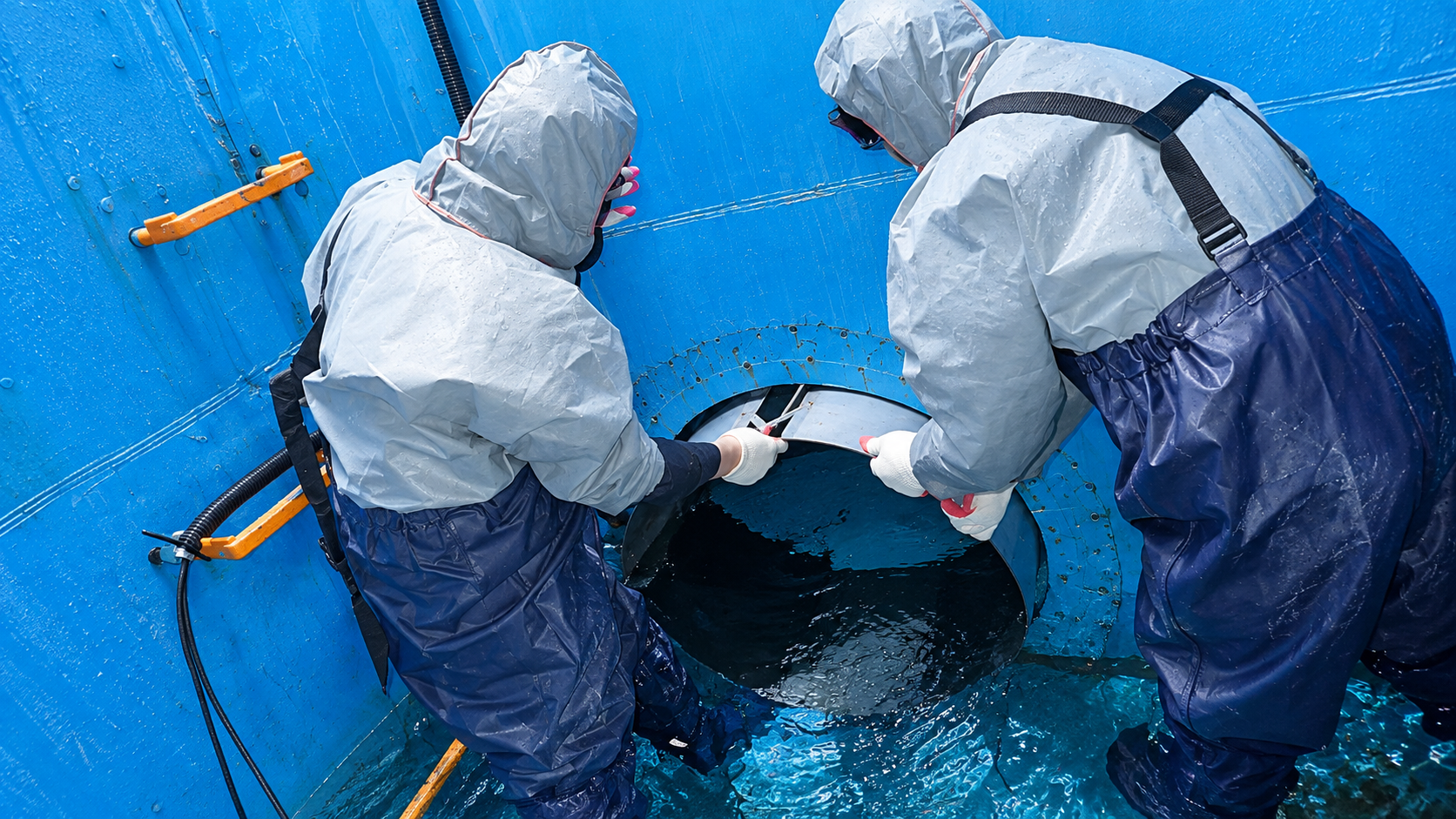
A U.S. firm develops a low-maintenance flowmeter that can measure a wide variation of sewage flow rates to improve efficiency and prevent flooding.
Introduction
Heavy rainfall from more frequent and intense storms and increased runoff water from urban development affect the efficiency and sustainability of sewer systems. It has become even more important to monitor sewer infiltration and inflow to prevent problems and accidents, such as basement backups and overflows or even urban flash floods
The challenge in sewer flow monitoring is in handling flow patterns having extreme fluctuations, ranging from no flow to torrential flows of heavy stormwater.
SmartMeasurement Inc., a U.S firm specializing in acoustic technologies, has developed an innovative solution that is designed to provide stable flow monitoring environments in sewer systems to improve efficiency and prevent accidents. SmartMeasurement’s sewer flow monitoring system is used for water flow measurement in sewer (pipe) systems, stormwater drainage systems, and effluent drainage systems. It can measure the flow at extreme velocities and levels, with the ability to detect velocities as low as 0.05 meters per second, and continue to measure flow in a full pipe. The system is also designed to avoid sediment and debris accumulation in the flow path.
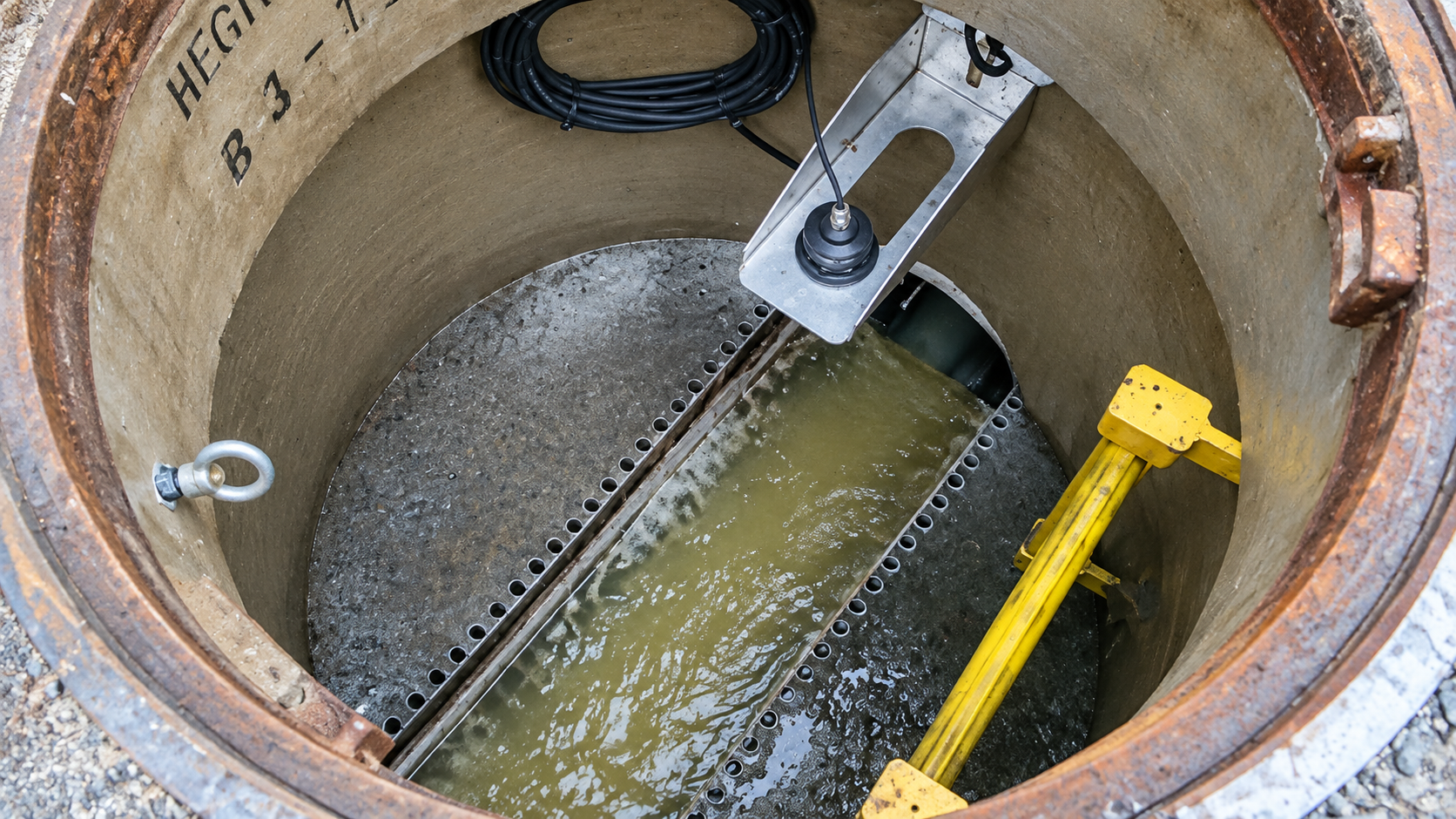
What Is Infiltration and Inflow?
Excessive infiltration and inflow reduce the cost-efficiency and capacity of sewer systems to manage and treat wastewater.
Infiltration enters a sewer system via defective sewer pipe joints, broken pipes, or manhole defects or degradation. It also occurs when sewer lines are poorly designed and constructed.
Inflow normally occurs when rainfall enters the sewer system through direct connections, such as roof leaders, yard drains, catch basins, sump pumps, defective manhole covers, and frame seals, or indirect connections with storm sewers (MassDEP, 2017).
Infiltration and inflow (I/I) comprise 40.2% of wastewater inflow to the wastewater treatment plant (Figure 1). I/I can overload the sewer system. The real water flow and quality can be quite different from the parameters used for the capacity design of the treatment plant (Choi and Chung, 2019)
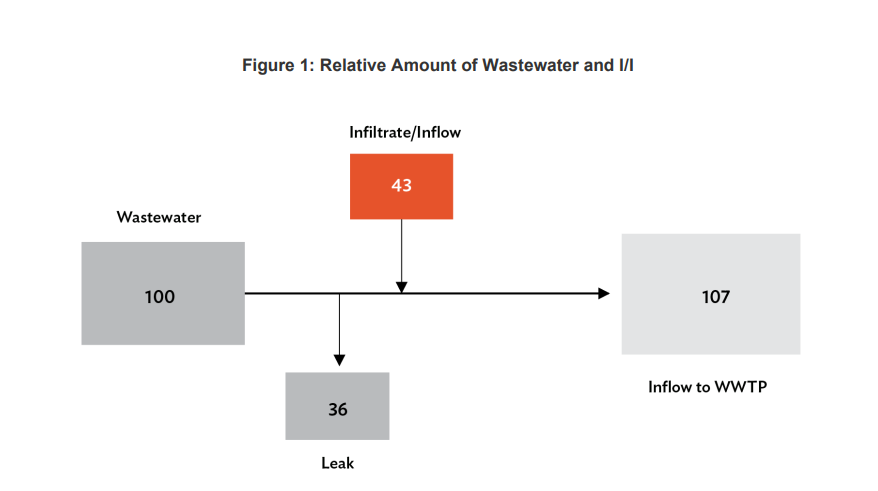
I/I = infiltration and inflow, WWTP = wastewater treatment plant.
Source: Park et al., 2006.
The biological process of wastewater treatment is sensitive to the characteristics of wastewater, including the concentration of nutrient organics, pH, and temperature. I/I changes the characteristics of wastewater inflow into the treatment process (Figure 2), which decreases the efficiency of the process (and increases the cost and possibility of sanitary safety risk).
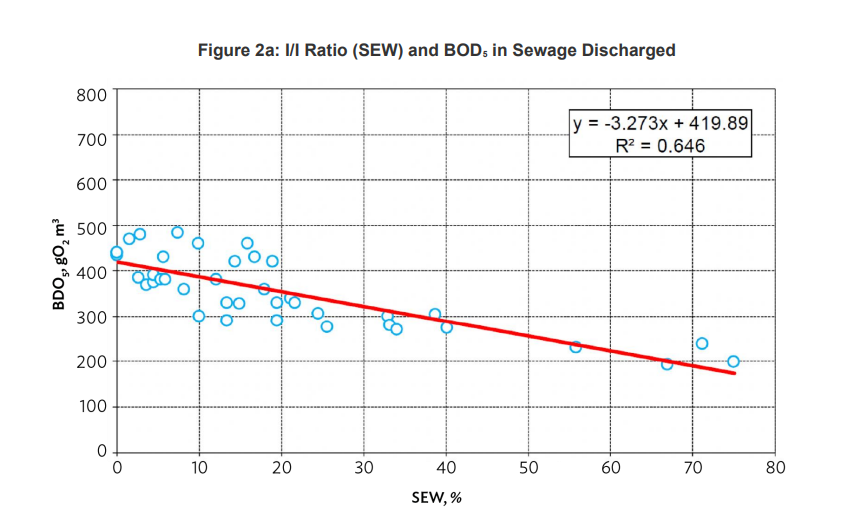
I/I = infiltration and inflow, SEW = extraneous water share, BOD5 = biological oxygen demand.
Note: Kaczor et al. defines SEW as ‘Qdi/Qdw x 100’ where Qdi is daily inflow penetrating into a sewer system [m3 /day] and Qdw is daily quantity of a mixture of actual sewage and an inflow delivered to a sewerage system during wet weather [m3 /day].
Source: Kaczor et al., 2017.
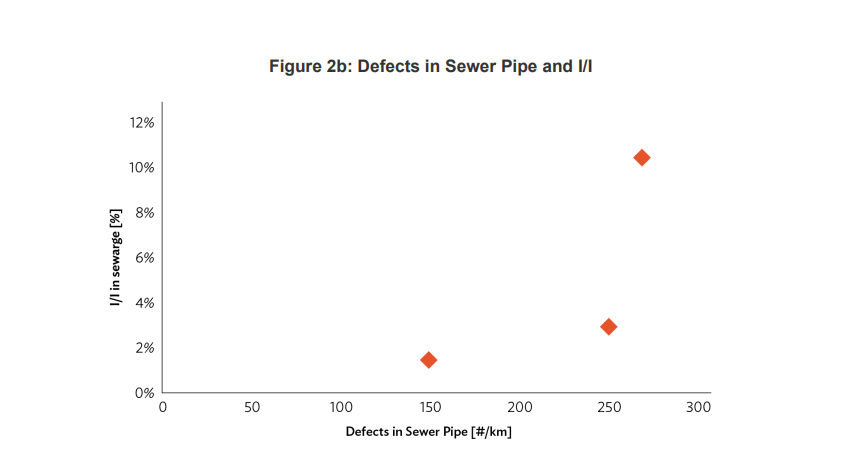
Source: Park et al., 2006.
Another problem is sewer pipe overflow. When the overflow is combined with 1) heavy stormwater due to climate change and 2) increased concrete/cement surface areas in urbanized environments, this results in an urban flash flood. Optimizing the design and operation of the sewer system can reduce the risk of flash flood in a city.
A recent report from the World Resource Institute measures water-related flood risks around the world. It finds that by 2030, 15 million people and $177 billion in urban property will be impacted annually by coastal flooding, while 132 million people and $535 billion in urban property will be affected by riverine flooding (WRI, 2020).
The simulator used for the report, Aqueduct Floods, finds that every $1 spent on flood protection infrastructure in India results in $248 in avoided damages and reduces the likelihood of these areas being flooded by half. In Bangladesh, every $1 spent on flood protection infrastructure results in $123 in avoided damages and reduces the likelihood of floods to 4% from 20% (WRI, 2020).
The mitigation of I/I by sewer system rehabilitation and inflow source removal, combined with an ongoing operation and maintenance program, are essential in protecting the environment and the significant capital investment in sewers and wastewater treatment facilities (MassDEP, 2017).
The Solution
Efficient and agile decision-making for sewer systems requires an accurate and resilient flow monitoring system.
The challenge starts from water flow measurement itself as the velocity of water in a sewer pipe is much less than 0.3 meter/second without rain. With heavy rain, the pipe is full of water with enormous pressure and velocity. Both these extreme conditions make accurate measurement of water flow in the sewer pipe challenging (Figure 3).
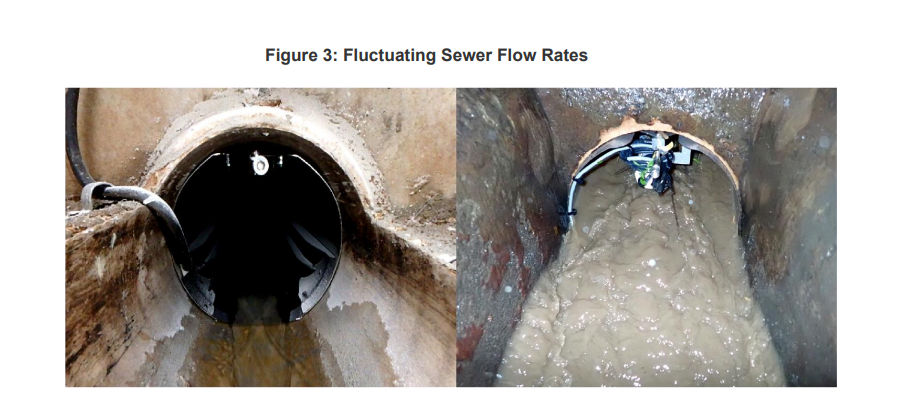
Left: Without rain. Right: During a rain event.
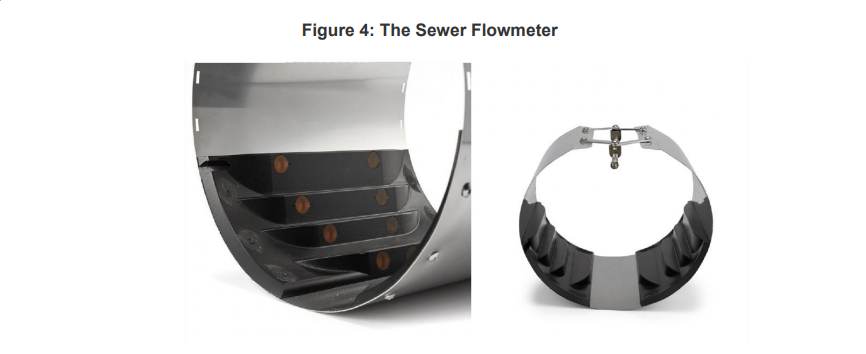
SmartMeasurement has developed a flow monitoring system that considers the extremely harsh conditions in the sewer pipe. The system uses a 4-path ultrasonic transducer array to measure the flow velocity and a level transmitter to receive the level data. The dimension of the system is very flexible, accommodating sewer pipes having diameters ranging from 6” (150 mm) up to 48” (1,200 mm) or more (Figure 4).
The transducers measure the fluid velocity of each channel based using transit-time cross correlation ultrasound technology. The transit-time difference is proportional to the velocity of fluid when the measured fluid is homogeneous, such as clean water, with a constant flow pattern. However, the flow of a non-homogeneous fluid with is more difficult to measure. The cross-correlation method, which is commonly used in signal processing, enables a much more accurate transit-time difference estimation as it is virtually affected by gas bubbles and particles in the fluid.
By applying the transit-time cross correlation technology, the system can measure the wide variations in sewage flow rates typically seen over the course of a day – from the lowest flow velocity at midnight, which is almost zero (Figure 5), to the highest velocity of 10 m/sec with heavy stormwater (Figure 6). Even under these harsh conditions, an accuracy level of 2% is maintained.
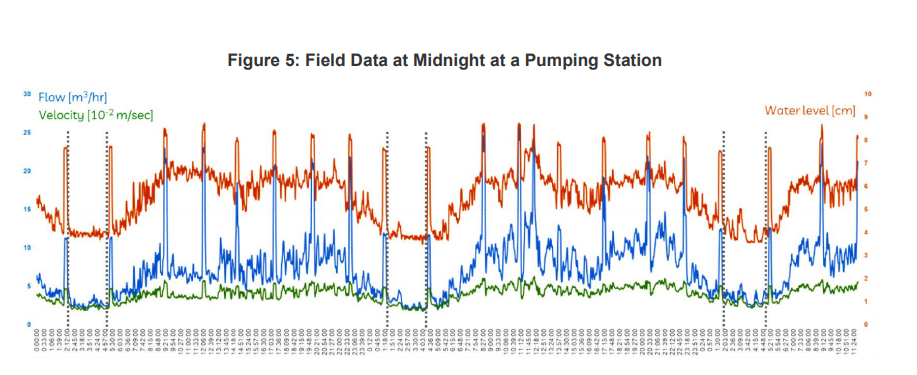
m3/hr = cubic meter per hour, m/sec = meter per second, cm = centimeter.
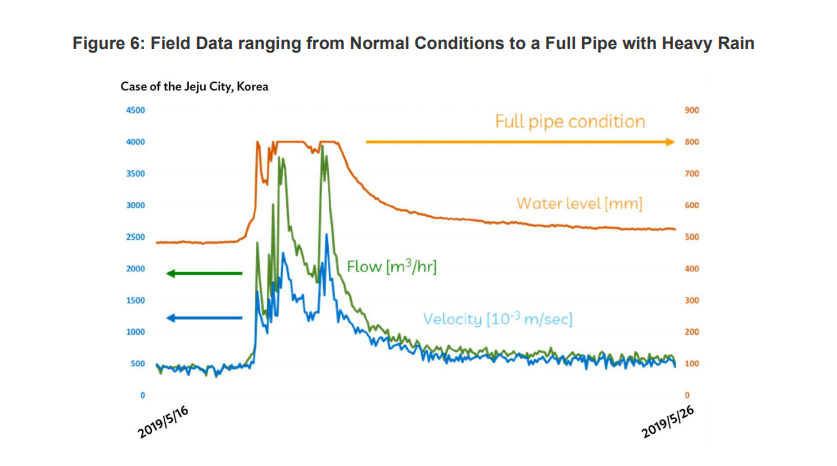
m3/hr = cubic meter per hour, m/sec = meter per second, mm = millimeter.
The Doppler-type flow meter (one of the popular technologies in the market ) used in this example, can only at best intermittently measure the water flow in the sewer pipe at midnight when the velocity < 0.3 m/sec (Table 1).
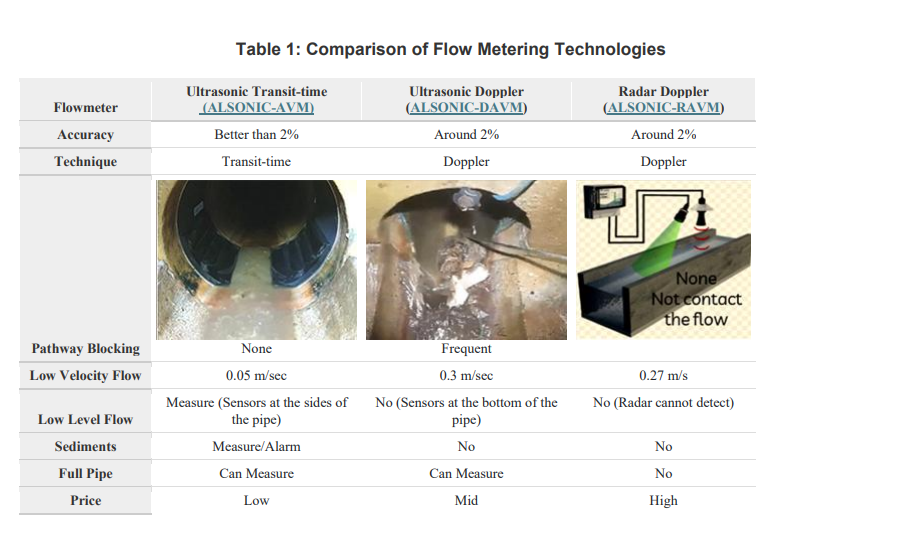
m/sec = meter per second.
The flowmeters currently available in the market are installed inside the pipe either at the bottom or at the top. Both have limitations. The sensor installed at the bottom cannot function if the water level is lower than the sensor. The system with the sensor installed at the top cannot measure the velocity of the water if the sensor is submerged in water. These sensors are also easily damaged by debris during extremely high velocity conditions and the high pressure that occurs with wastewater and stormwater.
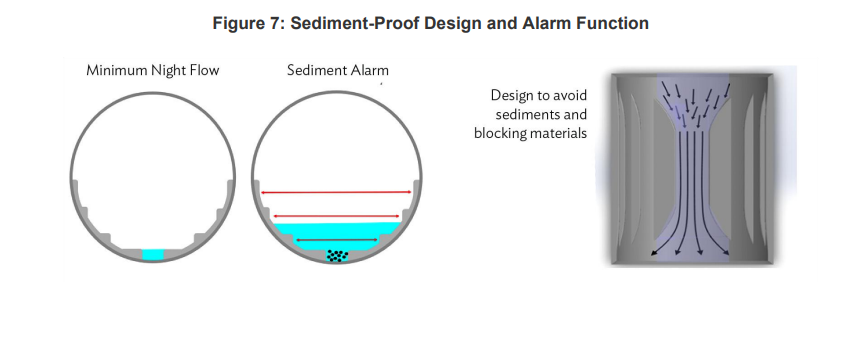
SmartMeasurement’s system is designed to avoid sediments and debris accumulation. It can detect sediment deposits, and it sounds off an alarm when the pipe needs to be cleaned. The system corrects the value of water flow, taking into account the sediments in the sewer pipe (Figure 7). This design reduces the need for repair and maintenance. One site in Asia has been operating for 3 years without any maintenance work. Some sites in harsher environments may need to be checked and cleaned one or two times a year. In comparison, the other solutions in the market need frequent or even weekly maintenance to check if the flow path is blocked with debris or sediments, or if the sensor is broken and not working correctly, or if the flow path needs to be cleaned.
As the system is fully digitized, data is transferred to the cloud or the server via telecommunication network, such as LTE and/or Internet of Things (NBIoT, Lora, and CAT M1).
Installation and Testing
The system has been installed at 10 sites in seven cities in Asai and North America. Four out of the 10 sites are stormwater drainage systems, four are sewer systems, and two are for the effluent discharge from water treatment plants. The system will also be tested in 10 more sites in five major cities.
The proposed monitoring system is ideally suited for sewer systems with extreme flow conditions (from no flow to raging torrent).
There are two types of sewer systems. When wastewater and stormwater from houses and buildings are separated and flow through different sewer and drainage system, the system is called “separated sewer system.” When they use the same sewer and drainage line, it is called “combined sewer system.” The proposed monitoring system is much more useful for the combined sewer system although the system is also beneficial for the separate sewer system to measure the water flow in the stormwater drainage pipes.
