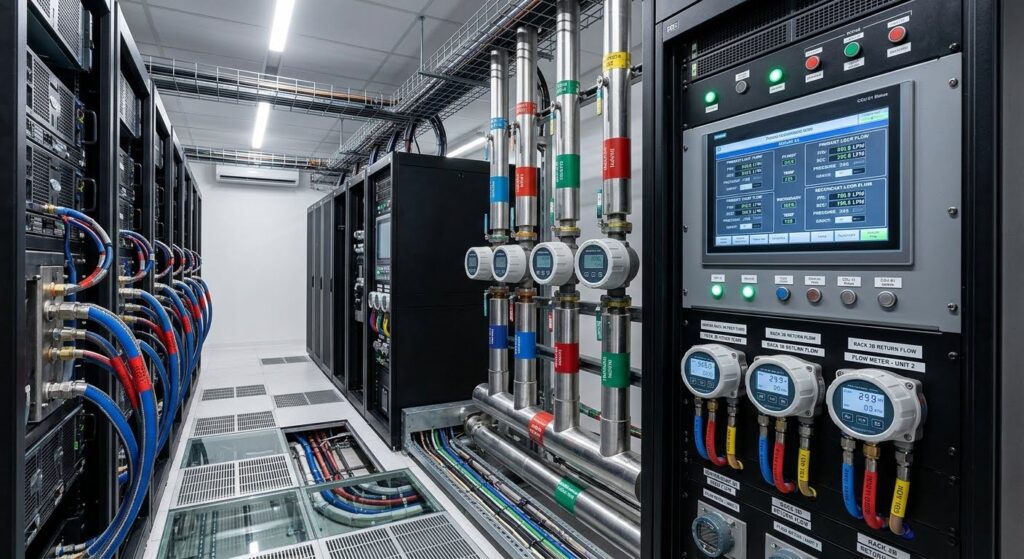
A coolant distribution unit (CDU) needs flow measured in three places: the facility water coming in, the secondary coolant going out to the servers, and the branches that feed each zone or rack group. For most CDU circuits carrying water or water-glycol, a compact magnetic flow meter is the best fit. It is accurate, it has no moving parts, and it adds almost no pressure loss to a tightly engineered loop.
AI and high-performance computing racks produce far more heat than conventional servers, and direct liquid cooling is how many facilities now remove it. The CDU sits at the center of that system. If its flow is wrong, every server downstream feels it.
This guide explains what a CDU does, where to measure flow, which meter suits each point, and how flow data reveals the cooling capacity a CDU actually delivers.
What a CDU does
A CDU separates the building’s facility water from the secondary coolant that circulates through server cold plates. It typically contains heat exchangers, pumps, valves, and pressure, temperature, and flow instruments.
The heat path runs in one direction:
Central chilled-water plant → facility water → CDU → secondary loop → distribution manifold → server racks and cold plates
Keeping the two loops separate protects sensitive IT equipment from the building’s larger, less controlled water system. It also lets the CDU control the secondary loop’s flow, pressure, and temperature precisely. That control depends on accurate flow data.
The three places to measure CDU flow
Each measurement point answers a different question, so a well-instrumented CDU uses all three.
| Measurement point | What it tells you | Typical pipe size | Recommended meter |
| Facility side (water to and from the CDU) | How much building water the CDU draws, and the heat it rejects to the plant | 2″ to 6″ | ALMAGWP magnetic flow meter |
| Secondary side (coolant from the CDU to the servers) | Whether the IT loop receives the flow it was designed for | 1¼” to 2″ (DN32 to DN50) | ALMAGSS compact magnetic flow meter |
| Distribution level (zones, manifolds, rack groups) | Whether coolant reaches every zone evenly | 1¼” to 2″ (DN32 to DN50) | ALMAGSS compact magnetic flow meter |
Facility side. This is the CDU’s connection to the chilled-water plant. Measuring flow here shows how much facility water each CDU uses. Combined with supply and return temperatures, it also shows how much heat that CDU sends back to the plant.
Secondary side. This loop serves the cold plates directly, so it matters most to IT uptime. A drop in secondary flow can raise processor temperatures quickly, so it needs to be caught early.
Distribution level. One CDU often feeds several rows or manifolds. Measuring each branch confirms that coolant is split evenly, and it helps find the zone that is short of flow before it becomes a hot spot.
Why magnetic flow meters suit CDUs
A magnetic flow meter measures the voltage a conductive liquid generates as it moves through a magnetic field. Water and most water-glycol coolants are conductive, which makes magnetic meters a natural fit for CDU circuits.
Four characteristics matter most inside a CDU:
- No moving parts. Unlike turbine meters, there is nothing in the flow path to wear, stick, or need replacing.
- Almost no pressure loss. The measuring tube is essentially unobstructed, so the meter adds very little restriction to a loop that is tightly engineered for pressure and pump energy.
- High accuracy. SmartMeasurement’s magnetic meters offer ±0.5% of reading as standard, with ±0.2% optional on the ALMAGWP.
- Compact, rugged options. Space inside a CDU is tight, and some magnetic meters are built specifically for it.
Choosing between the ALMAGSS and ALMAGWP
ALMAGSS for compact CDU circuits. The ALMAGSS combines the sensor and converter in one compact, all-stainless-steel assembly. It offers threaded or tri-clamp connections, 24 VDC power, IP67 protection and ±0.5% of reading accuracy, with pulse, 4-20 mA or RS485 outputs. It is currently available in DN32, DN40 and DN50, which suits secondary loops, distribution manifolds and equipment cooling circuits.
ALMAGWP for facility-side piping. The ALMAGWP is SmartMeasurement’s full-bore magnetic meter for larger lines, available from ½” to 80″ (DN15 to DN2000). For CDU facility-water circuits, typically 2″ to 6″, it offers ±0.5% of reading as standard and ±0.2% as an option, with 4-20 mA, pulse, RS485/Modbus, and HART outputs depending on configuration.
Always size the meter from the circuit’s minimum, normal, and maximum flow rates, not from the pipe diameter alone. A meter that matches the pipe but not the flow will not deliver its rated accuracy.
Check the coolant’s conductivity first
A magnetic meter only works with liquids that conduct electricity, at 5 µS/cm or more. Facility water clears this easily. Most inhibited water-glycol secondary coolants do too, but confirm it against the fluid’s data sheet.
Some secondary loops use deionized water or dielectric fluids, which do not conduct. A magnetic meter cannot read them. For those loops, SmartMeasurement’s ALCM Coriolis meter measures mass flow in any liquid, conductive or not.
Measuring the cooling capacity a CDU delivers
Flow alone tells you how much coolant is moving. It does not tell you how much heat is being removed. For that, you combine flow with the temperature difference between supply and return, known as ΔT.
Cooling rate = mass flow × specific heat × ΔT
For water in US units, this simplifies to a familiar rule of thumb:
BTU/hr ≈ 500 × flow (GPM) × ΔT (°F)
Here is a quick example. A CDU’s facility side carries 100 GPM with a 10 °F rise between supply and return:
- 500 × 100 × 10 = 500,000 BTU/hr
- That is about 146 kW of heat, or roughly 42 tons of cooling
The constant of 500 applies to water. Water-glycol mixtures carry less heat per gallon, so the constant is lower and should come from the fluid’s properties.
SmartMeasurement’s magnetic and ultrasonic flow meters can be configured with temperature inputs to make this calculation continuously. The result can go to a building management system (BMS), a data center infrastructure management (DCIM) platform, or a PLC, giving operators a live view of each CDU’s cooling load.
What CDU flow data reveals
Continuous flow monitoring is also a diagnostic tool. An unexpected drop in flow can point to:
- A failing or underperforming pump
- A partially closed valve
- A clogged strainer or filter
- A fouled heat exchanger
- Trapped air in the loop
- Hydraulic imbalance between branches
Add supply and return temperatures, and the picture gets sharper. Falling flow with a rising ΔT, for example, suggests the loop isn’t moving enough coolant to carry the heat.
Adding flow measurement to existing CDUs
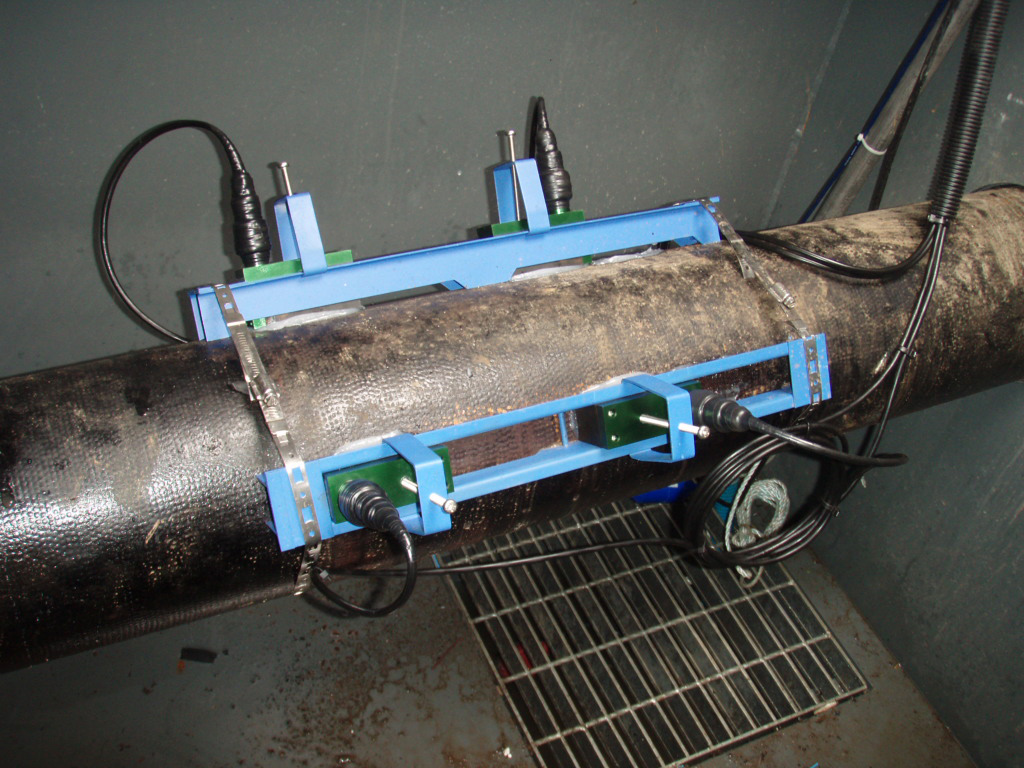
Inline magnetic meters are easiest to specify when a CDU is built or replaced. For an operating CDU that cannot be shut down, a clamp-on ultrasonic meter such as the ALSONIC-FX2 mounts outside the pipe with no cutting and no interruption. The portable ALSONIC-PL is useful for commissioning, balancing, and spot checks across many CDUs.
Frequently asked questions
What type of flow meter is best for a CDU?
For water and water-glycol coolants, a magnetic flow meter. It is accurate, has no moving parts, and adds almost no pressure loss. Use a Coriolis meter if the coolant is non-conductive.
Where should flow be measured in a CDU?
On the facility side, on the secondary side, and at the distribution level for each zone, manifold, or rack group.
Can a magnetic flow meter measure water-glycol coolant?
Yes, as long as the mixture conducts electricity at 5 µS/cm or more. Most inhibited water-glycol coolants do, but check the fluid’s data sheet.
How do you calculate a CDU’s cooling capacity?
Multiply mass flow by specific heat and by the supply-return temperature difference. For water, BTU/hr is roughly 500 × GPM × ΔT (°F).
Can flow meters be added to a CDU that is already running?
Yes. Clamp-on ultrasonic meters such as the ALSONIC-FX2 can be mounted outside the pipe without cutting it or stopping the flow.
Get the right meter for your CDU
The CDU is where facility cooling meets the IT load, and it is the last point where flow problems can be caught before they reach the servers. Measuring flow on the facility side, the secondary side, and every distribution branch gives operators that visibility. Adding supply and return temperatures turns those readings into a live cooling-capacity figure.
For most CDU circuits, compact magnetic meters such as the ALMAGSS and ALMAGWP offer the accuracy, low pressure loss, and long service life these loops need. Send Smart Measurement your coolant, line size, flow range, and temperatures, and an application engineer will recommend the right meter for each point in your CDU.