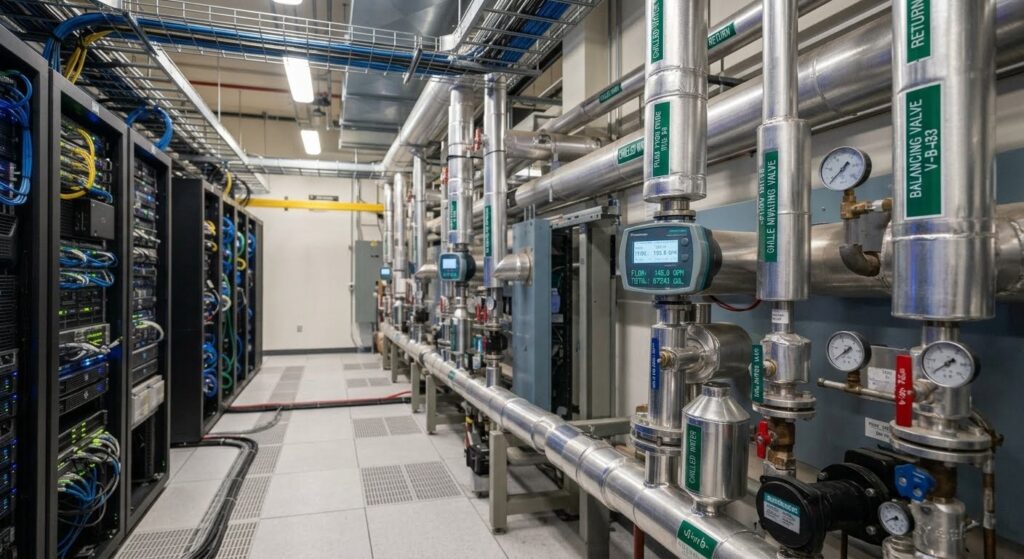
Cooling-water distribution is one of the important engineering considerations in a data centre. A cooling system may have multiple branches, pumps, valves, heat exchangers, and cooling loads, all of which need to work together to deliver the required thermal performance.
However, designing a cooling system correctly is only part of the challenge. Operators also need to understand whether the system continues to distribute cooling water as expected after commissioning, maintenance, upgrades, and changes in operating conditions.
This is where cooling-water balancing becomes important.
Flow measurement provides engineers with the information needed to understand how much water is moving through different sections of a cooling system.
What Is Cooling-Water Balancing?
Cooling-water balancing involves adjusting and verifying the distribution of fluid through different parts of a cooling system.
The objective is not necessarily to make every branch flow at exactly the same rate.
Instead, the flow should correspond to the requirements of the connected equipment and the design of the cooling system.
If one branch receives substantially more flow than required while another receives less, the system may not be operating as intended.
Why Imbalances Can Matter
An imbalance can create several operational challenges.
A branch with insufficient flow may not receive the cooling capacity expected by its connected equipment.
A branch with excessive flow may consume pumping capacity that could potentially be used more effectively elsewhere.
This makes measurement important.
Without actual flow data, engineers may need to rely on design assumptions, valve positions, pump specifications, or indirect indicators.
A flow meter provides direct measurement of the fluid movement at the selected location.
Why Flow Meters Are Useful for Balancing
A flow meter can be installed at strategic points to measure actual flow.
Engineers can then compare measured values with:
● Design flow requirements
● Expected branch flow
● Historical measurements
● Other cooling branches
● Pump operating conditions
● Supply and return temperatures
This can help identify areas that require further investigation or adjustment.
Magnetic Flow Meters for Permanent Balancing Points
For measurement points that will be monitored permanently, the Magnetic Flow Meter is one of the most widely used technologies in data-centre cooling systems.
Chilled water and condenser water are conductive, which makes them well suited to magnetic measurement. A magnetic meter has no moving parts, does not obstruct the pipe, and adds effectively no pressure loss. That is an important point in a balancing project, where the aim is to understand the system’s hydraulic behaviour rather than add to it.
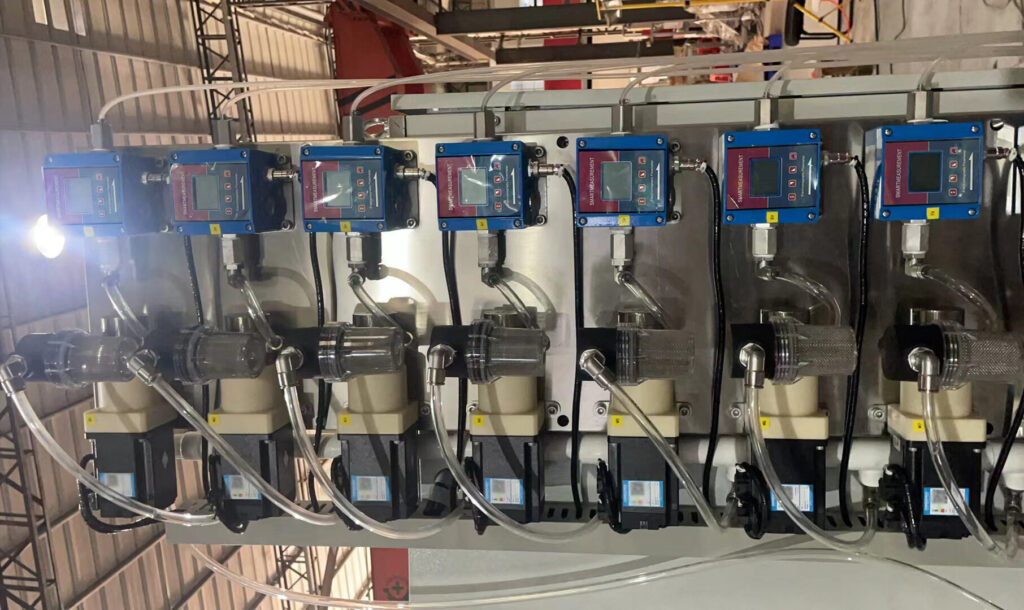
Magnetic meters are inline flowmeters that are flanged or threaded into the pipe, and they offer better accuracy than non-intrusive methods. Smart Measurement’s ALMAG Series Magnetic Flow Meters are intended for conductive liquids such as water, provide ±0.5% of reading accuracy as standard, and measure flow without moving parts. That accuracy is valuable in balancing, where engineers are often comparing branch flows that differ by only a small margin.
The ALMAG-SS is a spool-piece, all-stainless-steel magnetic meter capable of providing mass flow, flow, temperature, and BTU measurement. Available in sizes of ½” to 2″ (15 to 50 mm), it is designed especially for cooling and energy measurement where a compact, more rugged magnetic flow meter is required, making it a good fit for smaller branch circuits.
The ALMAG-EG is an electromagnetic energy flow meter that incorporates temperature measurement and energy calculation, and is available from ½” to 120″ (15 to 3000 mm) for anything from branch lines to main headers. Smart Measurement identifies it as well suited to cooling applications with low differential temperatures.
For branches that only need flow rate, the value-priced ALMAG-WP is a general-purpose magnetic meter used in cooling water and heat exchanger applications.
Smart Measurement notes that both the ALMAG-EG and the all-stainless-steel ALMAG-SS are particularly suited to chilled-water applications and can be used where the fluid contains more bubbles or particles than recommended for its ultrasonic energy-meter alternative.
For large headers that cannot be taken out of service, the ALMAG-IS Insertion Electromagnetic Flow Meter offers a hot-tap ball valve option, allowing the sensor to be installed and retracted without shutting down the process.
The user must still balance the better accuracy of a magnetic flowmeter against the easier installation of non-intrusive ultrasonic flowmeters. This highlights an important point: technology selection should be based on actual application conditions.
Portable (non-intrusive) Flow Measurement for System Audits
Not every measurement point needs to become a permanent installation.
During commissioning, maintenance, or troubleshooting, engineers may simply need to verify flow at multiple locations.
This is where portable Ultrasonic Flow Meters can be particularly useful.
Smart Measurement’s portable clamp-on range includes products such as the ALSONIC-DSP, which the company describes as a portable diagnostic tool for liquid applications and flow verification.
Because clamp-on sensors are installed externally, engineers can take measurements without cutting the pipeline.
This makes portable ultrasonic technology useful for investigating different sections of an existing cooling network.
Permanent Non-Intrusive Flow Monitoring
Where a measurement point needs continuous monitoring but an inline magnetic meter cannot be installed, a permanent clamp-on meter can be used.
The ALSONIC FX and the ALSONIC-DSP are fixed-mount clamp-on ultrasonic flow meters designed for non-invasive liquid flow measurement. They support a broad range of pipe sizes and provide outputs including Modbus, analogue, and pulse options. The ALSONIC FX is an economical permanently installed flowmeter capable of measuring liquids with less than 1-2% particles or bubbles, with a velocity range of 0.1 to 10 mps (meters per second). The ALSONIC-DSP and its portable cousin, the ALSONIC-DSPPL, are technically superior, capable of measuring liquids with up to 30% bubbles or particles, with a velocity range of 0.02 to 20 mps.
This can make them suitable for permanent monitoring where the facility needs continuous flow information without modifying the pipe.
Using Energy Meters for Cooling-System Balancing
Some applications require more than flow rate.
Energy flow meters measure flow and temperature and calculate thermal energy consumption. The ALMAG-EG provides this through inline magnetic measurement, while the ALSONIC-EG Ultrasonic Energy Flow Meter offers a clamp-on alternative that can provide data through communication protocols including BACnet, Modbus, and M-Bus for BMS integration. Smart Measurement notes that clamp-on ultrasonic energy meters typically achieve 1-2% accuracy, lower than electromagnetic energy meters, so the ALMAG-EG is the stronger choice where accuracy is the priority.
For cooling-system balancing, this can provide additional context.
Suppose two branches have similar measured flow rates but different temperature behaviour. The additional thermal information can help engineers investigate whether the difference is related to the thermal load, system conditions, or another factor.
A Practical Cooling-Water Balancing Process
A data-centre engineering team could approach a cooling-water balancing project in several stages.
Step 1: Understand the system
Document the cooling architecture, including:
● Pumps
● Main headers
● Branches
● Heat exchangers
● Cooling equipment
● Valves
● Existing meters
● Supply and return lines
Step 2: Establish expected flow
Determine the expected flow for each relevant circuit based on engineering documentation and equipment requirements.
Step 3: Measure actual flow
Use permanent or portable flow measurement to determine the actual operating conditions.
Permanent Magnetic Flow Meters provide accurate measurement at key points such as main headers and critical branches. Clamp-on (non-intrusive) Ultrasonic Flow Meters can be useful for spot checks or when existing piping should not be modified.
Step 4: Compare measurements
Compare actual measurements against expected conditions.
A difference does not automatically mean there is a problem. Engineers should investigate the system conditions and measurement uncertainty before making adjustments.
Step 5: Investigate significant differences
Potential areas of investigation may include:
● Valve settings
● Pump operation
● Pipe restrictions
● Filters
● Air in the system
● Changes in cooling demand
● System modifications
Step 6: Re-measure
After adjustments or maintenance, measurements can be repeated to verify the result.
Choosing Between Magnetic and Clamp-On Measurement
Data centres cannot always treat cooling infrastructure like an ordinary industrial process.
The cooling system may be supporting critical computing equipment, making intrusive installation undesirable.
Smart Measurement’s clamp-on Ultrasonic Flow Meters are designed to attach externally to the pipe, eliminating the need for pipe cutting for installation. The company specifically identifies HVAC and chilled-water applications for these meters.
This can make them particularly relevant for retrofit assessments and balancing projects.
For measurement points that will be monitored over the long term, many facilities install magnetic meters during planned maintenance windows, using clamp-on ultrasonic meters for the initial survey and the ALMAG-IS hot-tap insertion meter where a large header cannot be taken out of service.
In practice, the two technologies work well together: ultrasonic meters to investigate, magnetic meters to monitor.
Flow Balancing and Energy Efficiency
Balancing is not only about maintaining cooling performance. It can also provide information relevant to energy management.
If pumps are moving more water than necessary, there may be an opportunity for optimization. However, flow reduction should never be performed simply to reduce pumping energy without considering the cooling requirements of connected equipment.
Meter selection plays a part here too. Because a full-bore magnetic meter adds effectively no pressure loss, it does not add to the pumping load it is helping to measure.
The objective should be appropriate flow for the required thermal load.
The ALMAG-EG and ALSONIC-EG can both support this type of analysis by providing flow and thermal-energy information. Smart Measurement notes that the ALSONIC-EG can calculate cooling-load-related parameters such as kW/ton, COP, and EER using its inputs.
Turning Balancing into Ongoing Monitoring
Once the system has been balanced, permanent flow meters, typically magnetic meters on key headers and branches, can provide ongoing visibility.
Operators can establish normal operating ranges and investigate meaningful deviations.
This turns balancing from a one-time engineering exercise into part of continuous cooling-system management.
Conclusion
Cooling-water balancing is an important part of maintaining predictable cooling performance in complex data-centre environments. Accurate flow measurement gives engineers a direct way to understand how water is distributed through the system and whether operating conditions align with design expectations.
For permanent measurement on conductive cooling water, Smart Measurement’s ALMAG Series Magnetic Flow Meters, including the general-purpose ALMAG-WP, the ALMAG-EG energy meter and the all-stainless steel ALMAG-SS, provide accurate, low-maintenance measurement with no moving parts and negligible pressure loss. The ALMAG-IS insertion meter extends magnetic measurement to large pipelines that cannot be shut down.
Where users require a non-intrusive flow meter, portable ALSONIC-DSPPL Ultrasonic Flow Meters can support flow verification and system audits, while the fixed ALSONIC FX and ALSONIC-DSP provide permanent non-invasive measurement.
Where clamp-on thermal-energy measurement is required, the ALSONIC-EG provides combined flow, temperature, and energy measurement with BMS communication capabilities.