Data Center Cooling
Every cooling loop needs a number it can trust.
SmartMeasurement flow meters give data center engineers the accuracy and uptime liquid-cooled infrastructure demands, from the chiller plant to the CDU to the cold plate, without taking cooling offline.
NIST-traceable calibration on every meter shipped
COOLANT PATH · SCHEMATIC
OVERVIEW
FACILITY
PLANT
Chiller / CHW loop
RACK /
COLD PLATE
Supply / return
FACILITY
PLANT
DLC · Immersion
Who this is for
Three roles, three different questions.
This page is built to answer whichever one you’re asking
Facility / Ops Manager
"Will this hit my PUE and budget targets, without shutting anything down?"
Clamp-on ultrasonic flowmeter installation with BTU energy metering ties directly into PUE (your cooling-to-IT power ratio) and utility cost reporting, with no downtime window.
MEP / Consulting Engineer
"I need published accuracy, turndown, and fluid compatibility, not marketing language."
Every technology below lists its real accuracy spec, line-size range, and fluid compatibility, ready to drop straight into a spec sheet.
Liquid Cooling Integrator
"I need flow verified at startup, and confidence it holds up on a live loop."
From purge-and-flush verification during commissioning to ongoing monitoring across dozens of CDU circuits, flow data stays available the entire lifecycle.
The Cooling Stack
One flow measurement problem, three different systems.
Facility chilled water, CDU loops, and rack-level liquid cooling each carry different pipe sizes, fluids, and accuracy demands. Here’s what fits where, and why
01
FACILITY CHILLED WATER PLANT
Chillers, cooling towers, primary & secondary loops
The building-level hydraulic system that removes heat from the data hall, largely unchanged in principle from any large commercial chiller plant, but with zero tolerance for a shutdown to install instrumentation.
02
COOLANT DISTRIBUTION UNITS (CDU)
The interface between the building loop and the IT loop
Smaller diameters, tighter accuracy requirements, and often glycol-mixed fluids. This is where facility-grade instrumentation stops being precise enough and rack-grade measurement takes over.
03
RACK & COLD PLATE LOOPS
Direct-to-chip cold plates and immersion tanks
Low flow, small line sizes, and, in immersion systems, a dielectric fluid (a non-conductive coolant fluid that server hardware can sit directly in) that simply can’t be read by an electromagnetic meter, since it isn’t conductive. This is the one layer where the fluid itself decides the technology
Technology Selection
Match the meter to the fluid, not the other way around.
A quick reference for what to specify at each stage, and the one fluid property that rules a technology in or out.
| Technology | Best fluid match | Install style | Where it fits | Key spec |
|---|---|---|---|---|
|
Ultrasonic clamp-on Alsonic series |
Chilled water, water-glycol mixes | Non-intrusive: clamps onto the outside of the pipe | Facility plant, CDU retrofit | No process shutdown to install±1–2% accuracyOptional 0.5% accuracy with 2-path AlsonicDSP |
|
Electromagnetic AlmagEG series |
Conductive water / glycol only | Inline, wetted electrodes | Facility plant BTU / energy metering | NIST-traceable calibration±0.2% of reading |
|
Coriolis ALCM series |
Dielectric fluid, glycol, any liquid, including non-conductive | Inline, compact for small diameters | CDU loops, cold plates, immersion tanks | Direct mass flow + density and temperature1/8"–12", to 0.1% accuracyNIST-traceable |
|
Thermal mass ATMF series |
Gas-side / refrigerant monitoring | Inline or insertion | Refrigerant loops, gas-side cooling systems | Wide turndown ratioLow-flow leak detection |
Featured Products
The four technologies that cover every stage of the data center cooling stack.
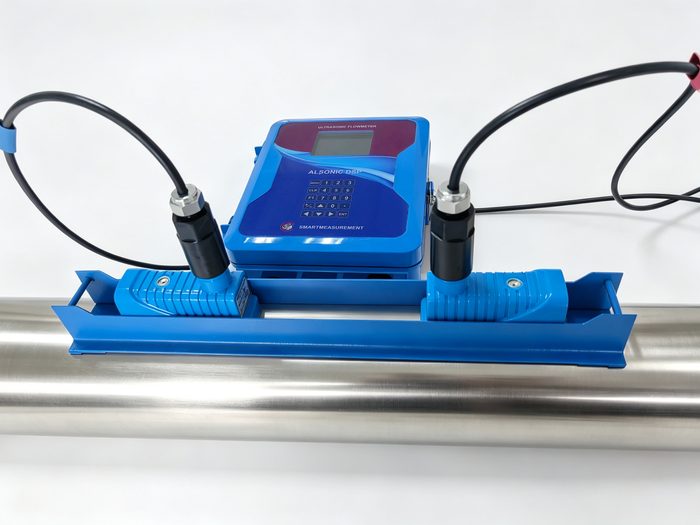
±0.5–1% accuracy
Alsonic Series
Transit-Time Ultrasonic Clamp-On Flow Meter
Non-intrusive install on a live line, zero downtime to commission.
±0.2% accuracy
AlmagEG Series
Electromagnetic Flow Meter
NIST-traceable BTU and energy metering for facility PUE tracking.
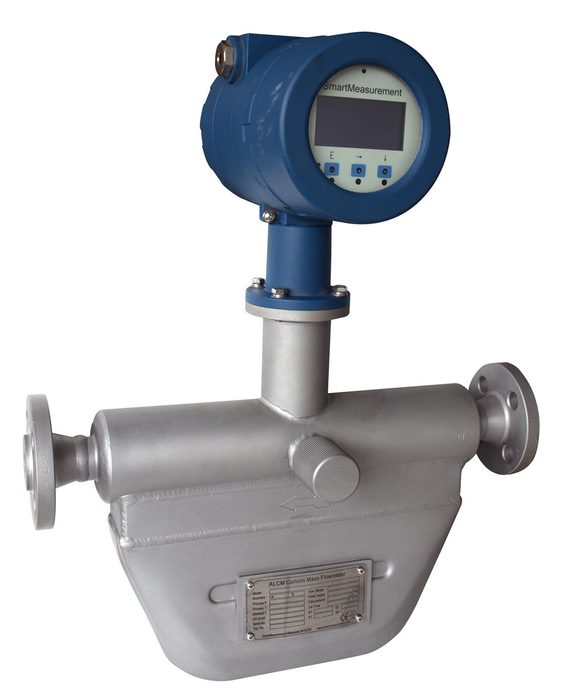
0.1% accuracy
ALCM Series
Coriolis Flow Meter
Direct mass flow and density, including non-conductive dielectric fluid.
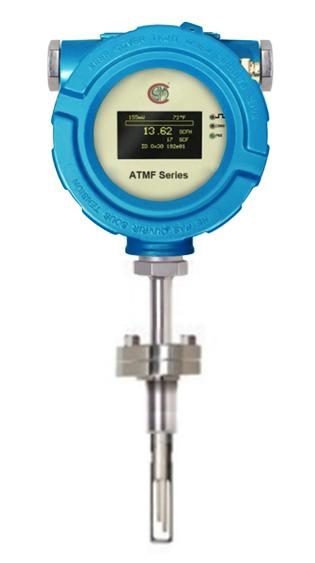
Wide turndown
ATMF Series
Thermal Mass Flow Meter
Gas-side and refrigerant loop monitoring with low-flow leak detection.
Why Engineers Spec SmartMeasurement
Answers to the questions that come before a purchase order.
NIST-traceable calibration
Every meter ships with a calibration certificate, not a claim document you can hand to your commissioning agent.
No downtime to install
Clamp-on ultrasonic technology reads flow through the pipe wall, no cutting into a live, mission-critical loop.
Published, not padded, specs
Accuracy, turndown, and line-size ranges are listed plainly so they can be checked against your design requirements directly.
No moving parts
Ultrasonic and Coriolis technologies carry nothing to wear out, meaning fewer truck rolls in a facility built around uptime.
Commissioning & Ongoing Verification
Flow has to be proven at startup, not just monitored after.
New liquid-cooled builds need every loop purged of air and debris before a rack ever comes online. Flow measurement is how that gets verified and documented, not guessed at.
- Confirm purge and flush velocity meets engineered spec before a loop is put into service
- Verify complete circulation through every branch of a multi-manifold CDU circuit
- Detect trapped air or restrictions before they become a hot spot in a live rack
- Document commissioning performance in a form owners and operators can keep on file
- Keep the same instrumentation in place for ongoing balance checks, not just a one-time startup reading
Frequently Asked
Straight answers, engineer to engineer.
Can a flow meter measure dielectric immersion cooling fluid?
Yes, but not with every technology. Dielectric fluid is non-conductive, which rules out electromagnetic meters entirely. Ultrasonic (clamp-on ultrasonic flow meters) can measure any liquid regardless of its chemical composition, while Coriolis (SmartMeasurement's ALCM series) measures mass flow directly regardless of the fluid's conductivity.
What's the difference between ultrasonic and Coriolis for CDU loops?
Ultrasonic clamp-on is the faster, non-intrusive option for retrofitting an existing CDU line without breaking the loop. Coriolis is the higher-accuracy, inline option, and it's required (not just preferred) when the fluid is non-conductive or when you need simultaneous density data alongside mass flow.
Can flow meters be installed without shutting down a live cooling loop?
Yes, with clamp-on ultrasonic technology. The sensors mount on the outside of the pipe and read flow through the wall and any insulation, so there's no cutting into the line and no shutdown window to schedule.
Do these flow meters work with propylene glycol or ethylene glycol mixtures used in direct-to-chip cooling?
Yes. Both ultrasonic and Coriolis technologies handle PG25/EG glycol mixtures common in direct-to-chip loops without requiring recalibration for the mixture ratio, which is a common pain point with other flow technologies.
How does flow measurement support PUE reporting?
Energy (BTU) flow meters combine flow rate with supply/return temperature differential to calculate actual thermal energy removed by the cooling system, the real-world input that PUE and cooling-load reporting depend on, rather than an assumed or design-basis number.
What accuracy do I need for CDU supply/return monitoring versus facility chilled water?
Facility-level chilled water monitoring for energy reporting typically runs well with ±0.2–1% class instruments. CDU and rack-level loops, where flow imbalance shows up directly as a thermal problem at the chip, generally call for the tighter end of that range, which is where Coriolis's 0.1% class accuracy earns its cost.
Can flow meters help verify purge and flush during commissioning?
Yes. Flow meters confirm that purge velocity is high enough to clear trapped air, debris, and particulate from a loop before it goes into service, and provide a documented record for the commissioning file rather than a visual estimate.
What line sizes are available, from rack-level manifolds to facility distribution headers?
Coriolis units run from 1/8" (3mm) for the smallest rack-level and cold-plate lines up to 12" (300mm). Ultrasonic clamp-on covers a broader range still, since it doesn't require a matched flow-tube size, and scales from small CDU piping to large facility distribution headers.
Get A Number You Can Spec
Tell us the loop. We'll tell you the meter.
Send over your fluid, line size, maximum and minimum flow rates, pressures and temperatures as well as your power and signal requirements, and where in the stack you’re measuring (facility plant, CDU, or rack loop), and we’ll come back with a specific product recommendation and quote.
Prefer to talk it through first? Talk to an Engineer →
Related Resources
Keep Exploring
Industries
All Flow Meter Applications by Industry
A broader look at how flow measurement shows up across process industries, beyond the data center cooling stack.
Adjacent Application
Building Automation & HVAC Flow Solutions
The same instrumentation logic applied to commercial HVAC and BAS-integrated chilled water systems.
Technology
Magnetic Flow Meters Overview
A deeper technical dive into electromagnetic flow meter theory, wetted materials, and accuracy specs.
